by Diana Horká
Richard Wagner’s final opera, Parsifal – a Bühnenweihfestspiel (festival play for the consecration of the stage) is a rarity on Czech stages. Wagner regarded Parsifal as his philosophical legacy, a seminal work illuminating complex ideas regarding the meaning of human existence, the significance of suffering, and spirituality. He was deeply concerned with the sanctity and the almost ritualistic context in which the work was to be performed, which is why the work was long restricted to performances in Bayreuth and thus reserved exclusively for an audience of Wagnerian initiates.
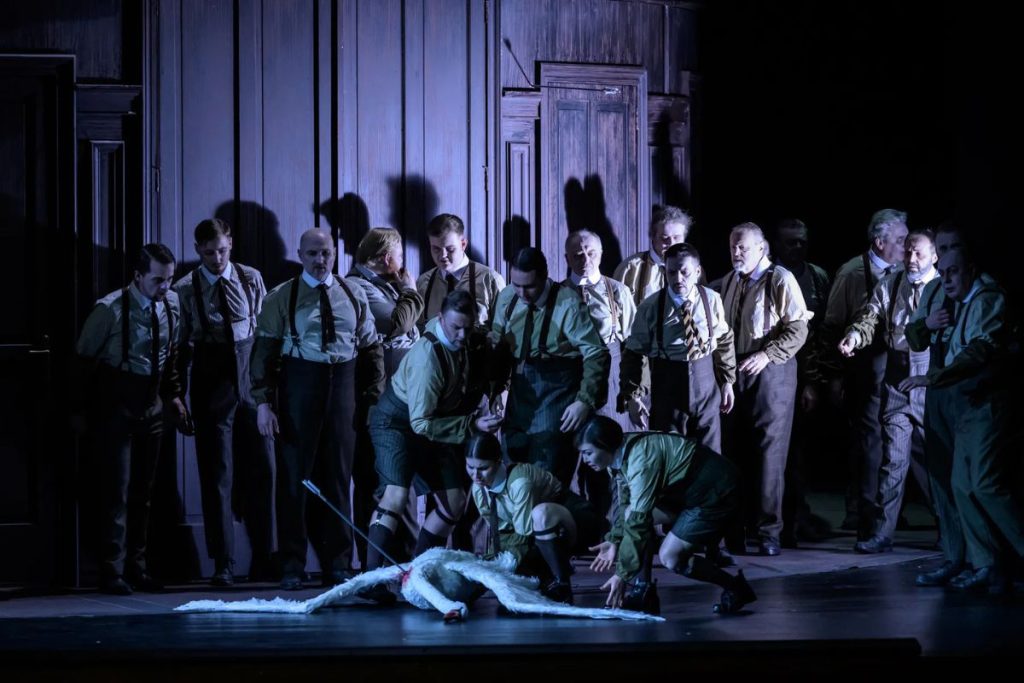
In Prague, the work premiered simultaneously at both the National Theatre and what is now the State Opera on January 1, 1914 – just one day after the official ban had been lifted. The National Theatre ensemble last performed Parsifal in 2011 after a 97-year hiatus; it now returns to the State Opera after nearly nine decades. The premiere on March 26, 2026, presented a modern production that replaces the castle of Monsalvat with a vast archive or library filled with countless doors. Director Andreas Homoki explains in the programme that this concept draws inspiration from Franz Kafka.
In the first act, this transposition was not distracting, though the solemn rite in a dusty library felt more like a gathering of conspiratorial hermeticists staged by Umberto Eco. Yet when the revolving stage revealed an immense sea of books, it created a striking effect, aligning with the mysterious monumentality of Wagner’s score. Still, the ceremonial atmosphere surrounding the Grail ritual—suggestive of a Mass or sacred rite – was at times undermined by moments bordering on the grotesque.
Traditionally performed around Easter, owing to the Good Friday setting of the third act, Parsifal contains unmistakable elements of Christian mythology: the Holy Grail, the spear that pierced Christ’s side, and baptism, through which the Christian faith triumphs over the pagan Kundry, who ultimately submits and attains redemption in death. In the State Opera’s production, however, this spiritual dimension is deliberately downplayed. While reinterpretation is certainly valid, one may question whether it is not somewhat banal for the Grail knights’ stronghold to transform overnight into something resembling Klingsor’s carnival fair. The desolation of the third act – expressed through empty shelves and scattered papers – does, however, vividly capture the despair of the brotherhood as it faces the suffering and death-bound King Amfortas.
A Nearly Ideal Parsifal and an Outstanding Kundry
The narrative is largely carried by Gurnemanz, here sung by Timo Riihonen. The Finnish bass offered a pleasant performance, though his upper register displayed a rather pronounced vibrato and was occasionally covered by the orchestra. One must credit his crisp, intelligible diction, though it occasionally came at the expense of vocal freedom and phrasing. The squires – Marek Žihla, Vít Šantora, Magdalena Hebousse, and Yukiko Smetáčková Kinjo – also delivered solid acting performances.
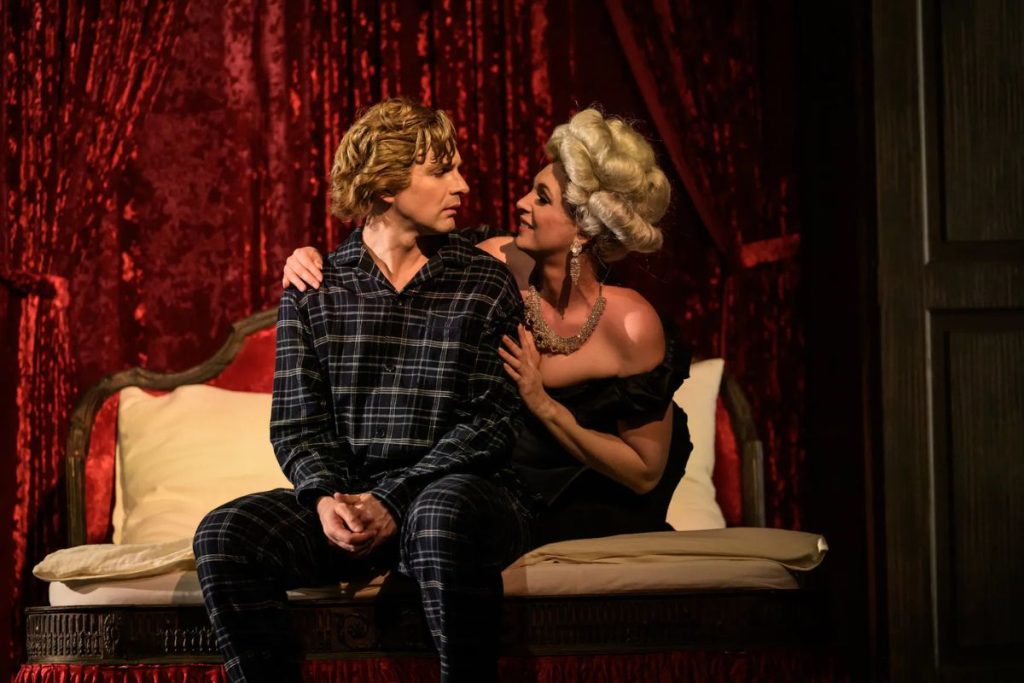
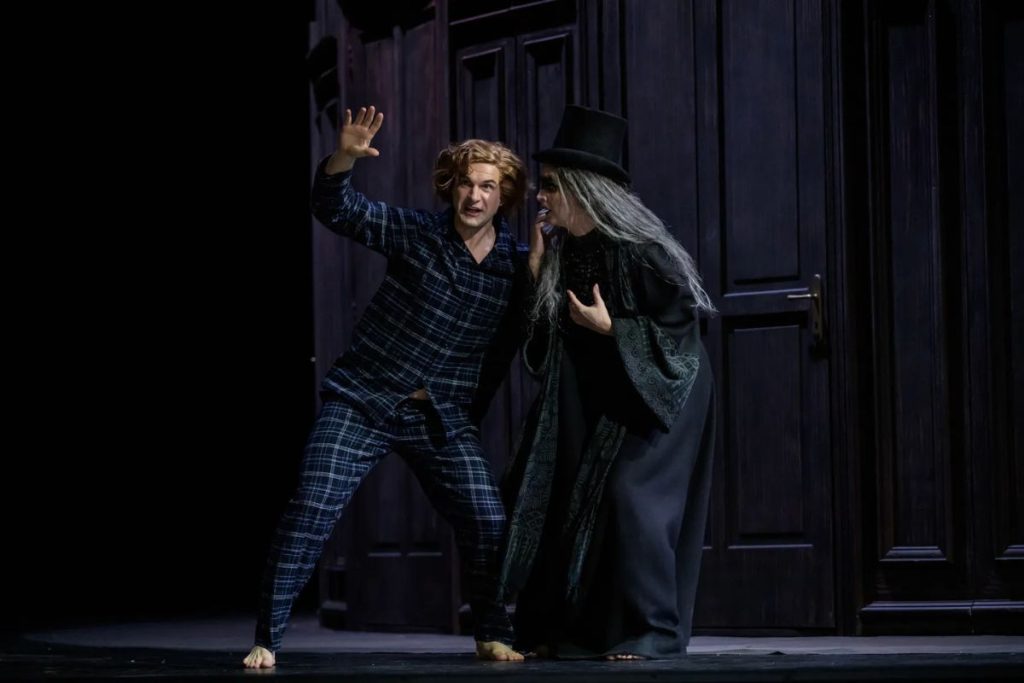
A touch of unintentional comedy arose from the discrepancy between the libretto and Parsifal’s costume: when Gurnemanz sings “Doch adelich schein’st du selbst und hochgeboren,” Parsifal’s pyjamas hardly support the claim. Matthew Newlin’s portrayal, however, was close to ideal. His German diction was excellent, the tone even and well-supported, resonant and free of strain. The flannel pyjamas effectively reinforced the character’s naïve persona – the “pure fool” in every sense. Newlin also convincingly traced Parsifal’s development, from lyrical youth to mature figure, mirrored in his vocal expression.
Ester Pavlů proved perfectly cast as Kundry, delivering an exceptional performance both vocally and dramatically. Her rich lower register and secure upper range were complemented by an early use of chest voice that suited the role particularly well.
The Feast of the Grail was peculiar. Titurel (Ivo Hrachovec), supposed to be on the verge of death, not already deceased, was instead brought on stage in a coffin, from which he rose pale as a vampire. His vocal delivery featured a pronounced vibrato, though this somewhat aligned with the character’s frailty. His vocal delivery was hampered by a very heavy vibrato, though it somewhat fit the character of a dying old man – and he was, after all, transported in a closed casket; who wouldn’t be trembling?
The Blinding Sight of the Grail
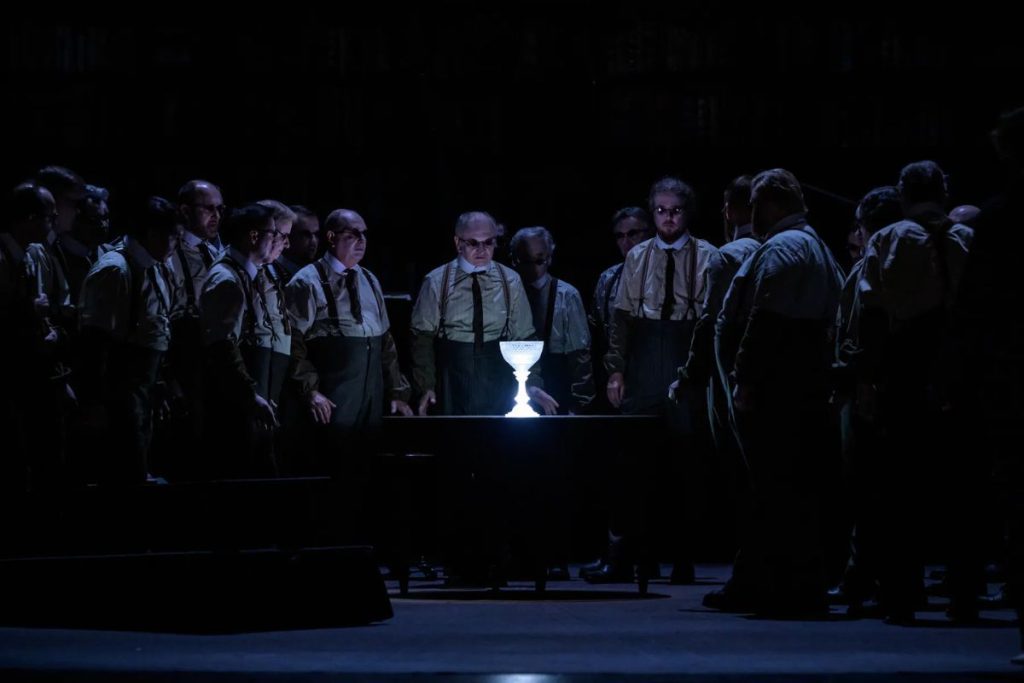
I appreciated the directorial conceit of the glowing Grail. However, the fact that the chorus had to don miniature black sunglasses to shield themselves from its light felt more grotesque than ceremonial. Jiří Hájek’s Amfortas sang with great feeling and a fluid onset of tone. I must particularly commend his “covering” in the upper register, which avoided the dullness often found in deeper voices. Still, there were moments where the orchestra drowned him out during forte passages.
Under the baton of Markus Poschner, a German conductor with extensive Wagnerian experience, including his own production at Bayreuth, the orchestra played with evident sensitivity and dynamic nuance, though greater balance with the singers would be desirable. The orchestral interludes and the prelude are rich symphonic poems in their own right. In the prelude, I admired Poschner’s sensitive touch and judicious tempo. Only occasionally were the entries of individual sections somewhat tentative. Generally, the purely orchestral passages were well-crafted. However, the off-stage bells during the first act Grail ceremony were less successful, sounding somewhat chaotic, and coordination issues affected the offstage women’s chorus and Kühn Children’s Choir, the latter also struggling with intonation. In contrast, the onstage male chorus, a combined ensemble of the National Theatre and State Opera choruses under the direction of Zuzana Kadlčíková, performed at a high level.
Flower Maidens and the Seductions of the Carousel
The second act introduced the sorcerer Klingsor, portrayed by Martin Bárta. The glowing crystal ball and the summoning of Kundry were visually effective. It took me some time to realize that the directorial intent was perhaps not a warlock, but a “sinister clown.” Bárta adopted a peculiar gait for the role, singing consistently forte and under some vocal strain. His Czech-inflected German diction did little to aid a performance that also faced intonation issues.
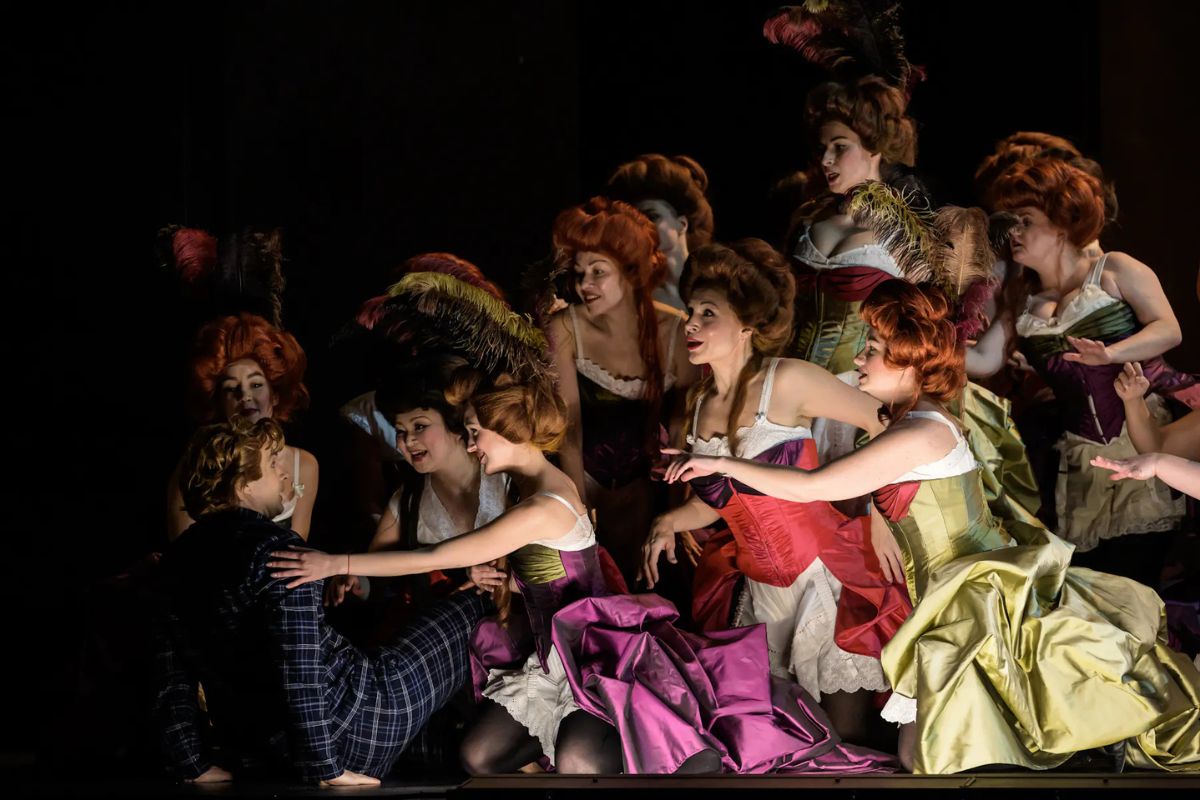
Parsifal then encounters the Flower Maidens (translated in the program as “Magic Maidens,” though the original Blumenmädchen favors “Flower”). Barbora Perná, Valeria Pronina, Magdalena Hebousse, Yukiko Smetáčková Kinjo, Stanislava Jirků, and Marie Svobodová offered lively stage action but vocally uneven performances. Pronina stood out with her bright, well-balanced tone, while Perná’s voice sounded less natural and less precise in intonation. The other ensemble voices did not stand out, leading to a somewhat disparate overall sound. One must, however, laud the speed of their costume changes – slipping dresses over white undergarments faster than the turntable could rotate. Equally swift was the insertion of the carousel – a symbol of Klingsor’s magic garden – into the library space. The audience never felt a lull or a vacuum on stage.
A further rotation revealed a bed where Kundry sat with the elegance of a pre-war film star, evoking the aura of Adina Mandlová – visually and vocally compelling. Her vocalism was equally arresting: with flawlessly supported, poised piani giving way to thrillingly taut forti across her entire compass, Ester Pavlů proved the role to be an ideal fit. By the close of Act II, she was quite rightly met with a roar of applause and cries of ‘Bravo.’ The same accolade belonged to her counterpart, Matthew Newlin, whose Parsifal displayed a voice masterfully schooled throughout every register and dynamic shade.”
The Arrival of Spring instead of Consecration
The orchestral interlude, Good Friday Music, felt somewhat lost in a rather brisk tempo and lacked rhythmic incisiveness, ushering in an Act III that was, at best, hesitant. While Andreas Homoki articulates his directorial vision in the program, it was not sufficiently legible on stage. Kundry was discovered not in the traditional thicket, but huddled beneath a mountain of paper like a vagrant. This I could accept, but why did she rush to embrace Parsifal? Should she not feel a sense of sacred awe? It made her appear to be the one in control, directing the “higher plan.” Her baptism at the hands of Parsifal was so fleeting – almost blink-and-you-miss-it, though the symbolism of vernal triumph, represented by a single radiant potted flower, was surprisingly poignant. Altogether baffling, however, was Gurnemanz’s wide-eyed collapse following the line ‘Heute ihren Unschulds Tag erwirbt’; he simply picked himself up immediately afterward to announce that it was midday, as if nothing had happened.
The final scene – Titurel’s funeral, the Grail ceremony, and the healing of Amfortas – yielded a result entirely at odds with Wagner’s original intent. After being healed, Amfortas seizes the Spear and stabs himself, dying in the arms of Kundry, who – instead of finding her own redemption in death – to raise a solitary flower aloft. The glow of the Grail again blinds the male chorus to the point of donning their “blind-man” glasses. Stripped of its sacred gravitas, the entire ceremony largely failed to evoke the profound ritual of initiation.
A Parsifal Worth Seeing
In many respects, this Prague Parsifal grazes the heights of international standards, and the production undeniably warrants attention. Vocal benchmarks remained consistently high, my various caveats notwithstanding. Indeed, within the current Czech operatic firmament, it is difficult to conceive of a Kundry portrayed with such arresting conviction as that of Ester Pavlů. Even without deep analysis, the production leaves a high-quality first impression. The most nagging reservations stem from a series of intriguing yet half-baked conceits; without recourse to the program notes, the directorial vision remains at times inscrutable, often side-stepping the work’s profound spiritual interiority. While the second scene of Act II – a masterclass in sophisticated seduction by a radiant Kundry – marked the evening’s dramatic zenith, Act III proved the least persuasive, drifting furthest from Wagner’s metaphysical anchors. Yet, if one is prepared to decouple the staging from Wagnerian philosophizing, a new and quite intriguing narrative emerges on stage.
Richard Wagner: Parsifal
26 March 2026, 6:00 PM
State Opera, Prague
Production Team
Conductor and Musical Director: Markus Poschner
Stage Director: Andreas Homoki
Set Design: Frank Philipp Schlößmann
Costume Design: Hannah Clark
Lighting Design: Franck Evin
Chorus Master: Zuzana Kadlčíková
Children’s Chorus Masters (Kühn Children’s Choir): Jiří Chvála, Petr Louženský
Dramaturgy: Werner Hintze
Cast
Parsifal: Matthew Newlin
Kundry: Ester Pavlů
Gurnemanz: Timo Riihonen
Amfortas: Jiří Hájek
Klingsor: Martin Bárta
Titurel: Ivo Hrachovec
First Knight: Josef Moravec
Second Knight: Miloš Horák
Four Squires: Magdalena Hebousse, Yukiko Smetáčková Kinjo, Marek Žihla, Vít Šantora
Flower Maidens: Barbora Perná, Valeria Pronina, Magdalena Hebousse, Yukiko Smetáčková Kinjo, Stanislava Jirků, Marie Svobodová
Voice from Above: Jana Sýkorová
Kühn Children’s Choir
National Theatre Chorus, State Opera Chorus
State Opera Orchestra