by Michal Rezek
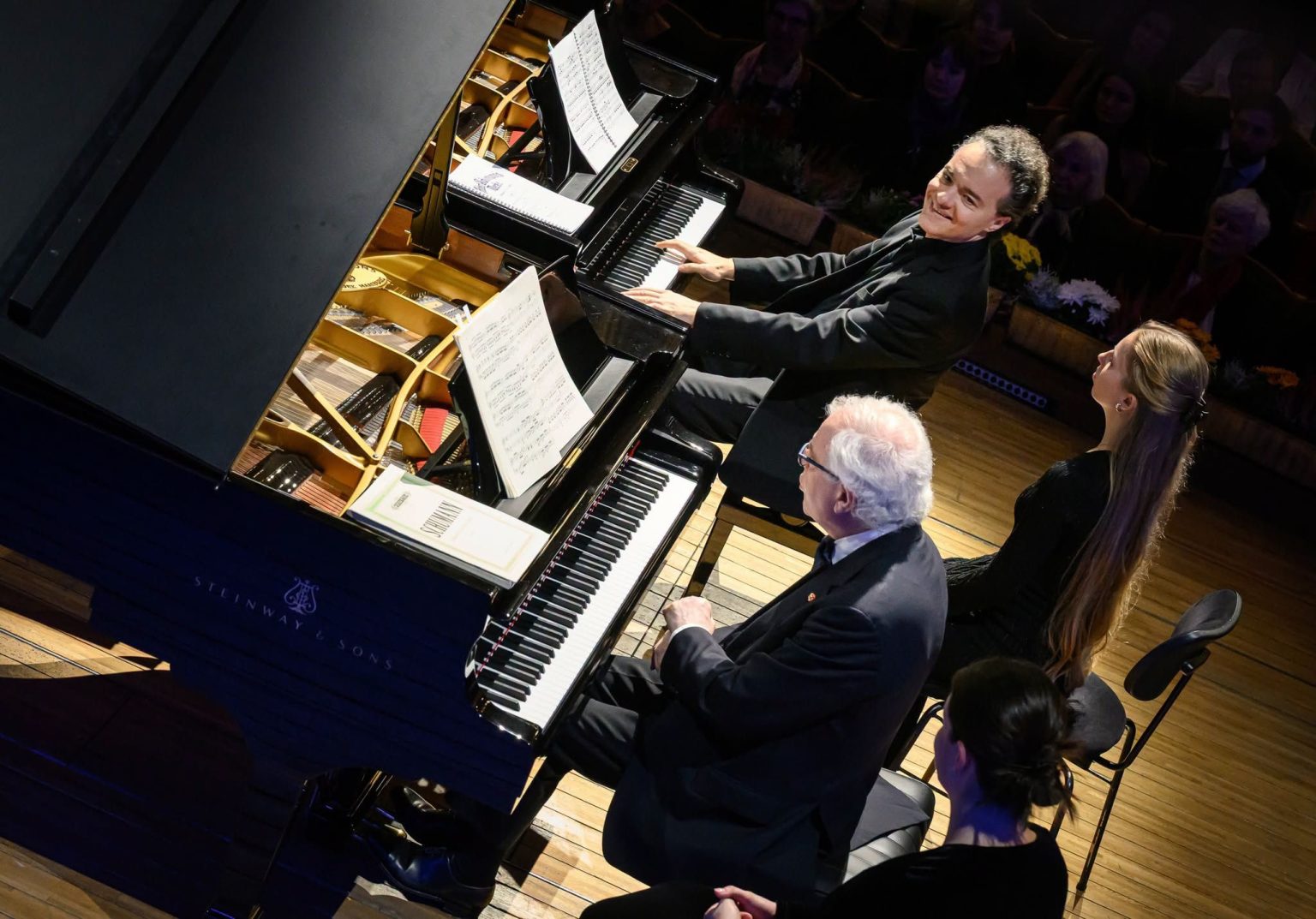
The programming team of the Prague Spring Festival pulled off a remarkable feat. For the opening concert of the Rudolf Firkušný Piano Festival, it managed to bring two international piano superstars together on the stage of the Rudolfinum: Evgeny Kissin and Sir András Schiff. This artistic partnership in the form of a piano duo was not entirely new; the two musicians had already performed together once before the COVID-19 pandemic. After the forced interruption, however, several years passed before they were able to find and set aside time for a series of twelve concerts at major cultural venues across Europe. I consider securing their appearance for the opening concert on 3 November 2026 something of a small miracle, and I believe the organisers deserve the heartfelt gratitude of Prague’s concertgoing public for such an extraordinary achievement.
When the completely sold-out Rudolfinum finally welcomed both artists onto the stage, the audience greeted them with admiring and enthusiastic applause. Both pianists made it clear how much they were looking forward to the moments ahead at the two pianos, and how much at home they felt in this particular venue.
Two Musical Personalities, Two Distinct Sounds
The programme opened with Mozart’s Sonata for Two Pianos in D major, K. 448, a joyful, lively and brilliant work, brimming with an inexhaustible wealth of musical and pianistic ideas. And this was precisely the spirit in which the two artists approached it.
Kissin and Schiff do not form a permanent duo in the way that, for example, the legendary Kontarsky brothers or the Pekinel sisters did, having devoted their entire lives to developing a unified musical language and a perfectly integrated sound. From the very first notes, it was clear that the two pianists possessed radically different tonal personalities. The foundations of their collaboration were undoubtedly mutual admiration, respect and, of course, an immense wealth of stage experience.
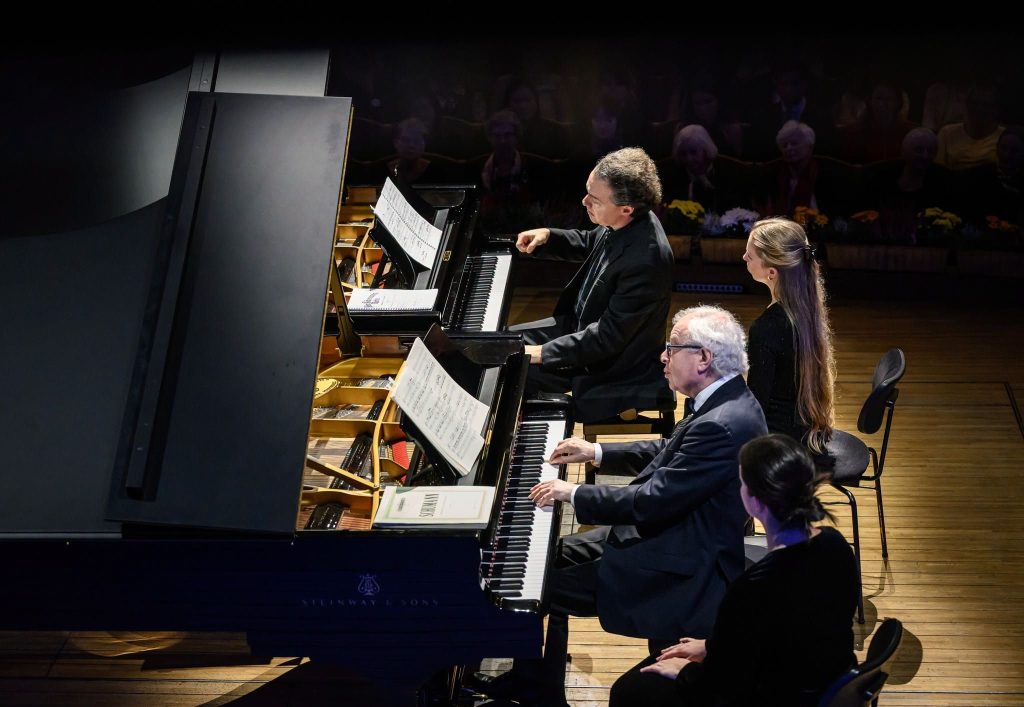
At the first piano, Evgeny Kissin brought boundless energy and irrepressible temperament to the stage. Even in Mozart, his sound was robust and sharply defined; he often gravitated towards the upper registers, delivering melodic lines with an urgent, expressive intensity. At the second piano, Sir András Schiff displayed his characteristic composure and almost effortless sense of perspective. Nothing seemed capable of surprising or unsettling him. His beautifully balanced, rounded and remarkably cohesive tone, combined with an instinctive understanding of the music and effortless command of the instrument, was truly admirable.
While Kissin often seemed inclined to sharpen the tempi and push them forward, Schiff adapted with remarkable flexibility, occasionally tempering the pace himself. Particularly effective were the subtle, beautifully judged relaxations of tempo, after which the music returned to its original pace with complete naturalness. The calm yet intensely felt second movement was especially beautiful.
Despite their contrasting tonal profiles, the sheer joy of their music-making was communicated directly to the audience. In my own case, the pleasure was effectively doubled: I thoroughly enjoyed listening to both pianists.
The second work of the evening was Robert Schumann’s Andante and Variations in B-flat major, Op. 46. The composition is distinguished by its striking melodic inventiveness, while both piano parts are extremely demanding, at times virtuosic in character. One of the work’s great strengths is the frequent alternation between the two parts: while one is highly exposed, the other is considerably more restrained, yet remains musically indispensable. This dialogue between the two pianos, combined with the changing moods of the individual variations, creates enormous scope for creativity, imagination and inventiveness, all of which the two artists exploited to the full.
Both demonstrated truly virtuoso command of their instruments. Beyond that, I particularly admired the instinctive musical understanding and responsiveness with which each responded to the other.
Another important detail was that the pianists exchanged positions: Schiff took the first piano, while Kissin moved to the second. This proved a considerable advantage in terms of the overall sound. Schiff, whose tone is more subtle, was now closer to the audience and therefore easier to hear, while Kissin’s enormous sonority was in no danger of being lost at the second piano.
Yet the moment that affected me most deeply in the entire performance was a single variation in B-flat minor, played by both masters at an extraordinarily slow tempo and with a deeply evocative, almost tragic sadness. Under normal circumstances, this is a modest, almost restful variation. Yet we witnessed how two great artistic personalities can give music an entirely different character and emotional meaning from what the composer himself may have intended.
It was also the moment when, both as human beings and as musicians, they became one body and one soul. For me, it was one of the most powerful moments of the entire concert. I was deeply moved, and it is precisely one of those experiences I know I will never forget. It also reminded me that art is among the highest expressions of human existence.
Before the interval, the two pianists exchanged positions once again. The programme continued with another charming and lively work by Robert Schumann, Pictures from the East, Op. 66. The tempo and character indications for all six pieces, as is customary with Schumann, are given in German. Their Czech translations sound rather charming – judge for yourselves: Lively – Not fast, and very songfully – In a folk style – Not fast, an Oriental song – Lively – Penitentially, devoutly. All six pieces were performed and interpreted in precisely the spirit suggested by these indications.
The Vltava in a Surge of Symphonic Energy and Dreamlike Pianissimos
After the interval, the audience eagerly anticipated the Czech part of the programme: Smetana’s The Moldau, in the composer’s own arrangement for piano four hands, followed by a selection of eight Slavonic Dances by Antonín Dvořák.
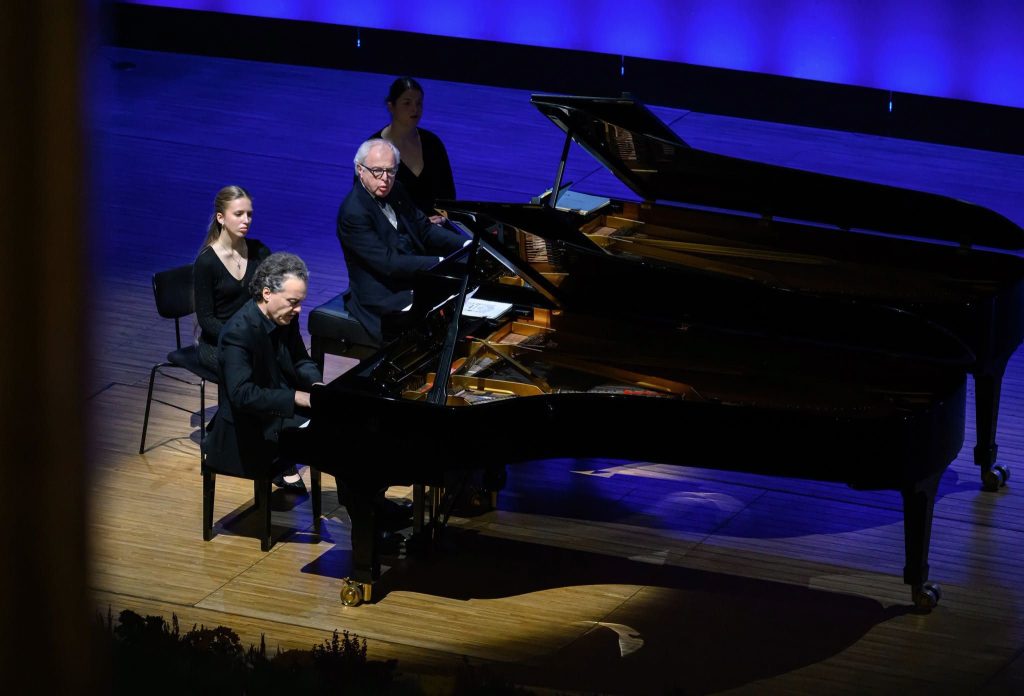
Evgeny Kissin took the first piano, with Sir András Schiff at the second. Anyone familiar with Smetana’s The Moldau for piano four hands, whether as a listener or a performer, knows perfectly well that it is a work for one piano played by four hands, not for two separate pianos. Schumann’s Pictures from the East is also a work for piano four hands. I had noticed the difference there, too, but had not given it much thought.
It is true that Smetana’s four-hand writing is complicated, and it is not always easy to accommodate four hands on one keyboard, sometimes with two players sitting side by side. Yet four-hand playing has an undeniable intimacy, a physical closeness and, with it, a particularly close musical and emotional rapport. It also facilitates ensemble playing: the slightest movements of the body, hands and individual fingers can be monitored visually, helping the performers achieve the greatest possible precision. Even so, this is rarely entirely successful.
Our two masters opted instead to use two separate instruments. One pianist played exclusively in the upper register of his piano, while the other confined himself to the lower half of his own keyboard. At times, this struck me as rather unnatural, although perhaps that is simply a matter of habit.
The one undeniable advantage of this arrangement was that each pianist could use the sustain pedal according to his own judgement and needs. This was particularly beneficial in Smetana’s The Moldau, where an ideal use of the pedal on a single piano is practically impossible to achieve.
However, anyone expecting a benchmark interpretation in the traditional Czech interpretative approach may have been disappointed. Kissin very quickly moved into a grand symphonic sound world. His energy was inexhaustible, relentless and extraordinarily sustained. He reached for the most expansive tempi and the most intensely charged sonorities, while Schiff sought to preserve the broad sweep of an orchestral interpretation, maintaining his characteristic calm and perspective.
The seemingly endless cascades of scales and runs were astonishingly convincing, as though neither pianist had any technical limits whatsoever. Yet the most beautiful moments for me were those in which the musical flow subsided or came to a complete standstill, allowing me to savour the almost magical pianissimo passages. It is hardly surprising that the performance was greeted with thunderous applause.
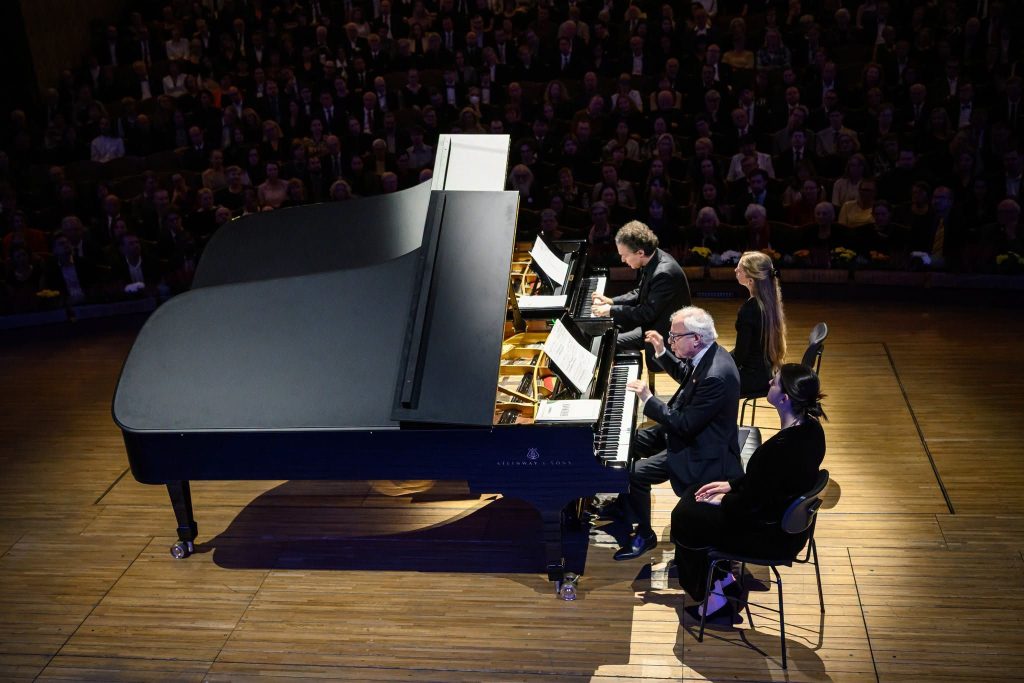
The selection of eight carefully chosen Slavonic Dances by Antonín Dvořák brought another exchange of positions at the pianos: Schiff took the first piano, Kissin the second.
The performance was wonderfully lively, with Schiff bringing considerable rhythmic vitality to the tempi. He frequently introduced elements reminiscent of Brahms’s Hungarian Dances, particularly gradual and pronounced accelerandos, which almost invariably led to astonishing speeds. Both masters handled them with breathtaking assurance and conviction. This was the first time that it was Schiff, rather than Kissin, who initiated the faster tempi.
The overall effect was highly persuasive. The universality of Dvořák’s music is truly remarkable. Although their interpretation was quite different from what we are accustomed to hearing, when confronted with pianists of such outstanding stature as Evgeny Kissin and Sir András Schiff, one can only bow to the conviction of their artistic personalities and musical vision. They are pianists of the highest calibre, and their interpretation was immensely compelling.
At the end of the concert, the artists offered three encores: Schubert’s Military March in D major, Op. 51, Brahms’s Waltz in A major, Op. 39, and the same composer’s Hungarian Dance No. 1 in G minor.
And then something quite extraordinary happened. These two pianistic legends finally sat side by side at a single piano and played a genuine four-hand performance! It felt so organic and natural, quite apart from being fantastically interpreted. Suddenly, everything was exactly as I would have imagined it.
After the concert, I independently asked both artists why they had not played all the works written for four hands in this way. Their answers were identical: “It is simply more convenient and comfortable.”
It was an unforgettable, extraordinary experience, one that is unlikely to be repeated any time soon.
To conclude, I cannot resist sharing a deeply moving personal moment with our readers. At the reception following the concert, Sir András Schiff spoke of his love for Prague and, with great humility, added that it was an incomparable privilege for him to be able to play Smetana’s The Moldau here, while the Vltava itself flows just fifty metres from the stage of the Rudolfinum.
Evgeny Kissin & Sir András Schiff
3 November 2026, 7.30 p.m.
Rudolfinum, Dvořák Hall, Prague
Programme
Wolfgang Amadeus Mozart: Sonata for Two Pianos in D major, K. 448 (375a)
Robert Schumann: Andante and Variations in B-flat major, Op. 46
Robert Schumann: Pictures from the East, Op. 66
Bedřich Smetana: The Moldau
Antonín Dvořák: Slavonic Dances, Opp. 46 and 72 (selection)
Performers
Evgeny Kissin – piano
Sir András Schiff – piano