by Josef Kratochvíl
Miroslav Tóth turned the second evening of the NODO festival into an apocalyptic teleshopping extravaganza, where opera genre disintegrates into physical theatre, improvisation, electronics, and grotesque ritual. White Death astounded with its sophisticated use of space, Bella Adamova’s powerhouse performance, and the seamless synergy of all its components. Yet, it deliberately left the audience suspended in limbo, wondering whether they were witnessing a chilling dystopia, a pitch-black comedy, or both at once.
The second day of the NODO 2026 festival belonged to a grandly conceived operatic extravaganza by Slovak composer Miroslav Tóth. Of all this year’s festival premieres, this production was undoubtedly the most demanding. Above all, the audience could appreciate the sheer abundance of unexpected twists and surprises devised by the composer in tandem with director Nela Husták Kornetová. At several points, I caught myself wondering more than once whether the whole thing was meant in earnest, or if it was a display of multi-shaded humour and hyperbole.
Tóth’s dystopian White Death serves as the loose final installment of a triptych performed at previous NODO editions, following Man in a Spacesuit (2020) and Nulanus (2022). In many respects, White Death patently negates any conventional operatic idiom. Barring the possibility that this is merely another layer of the composer’s jest, I would feel compelled to describe the piece as a species of “post-opera”.
How Humans Taught Trees to Shoot
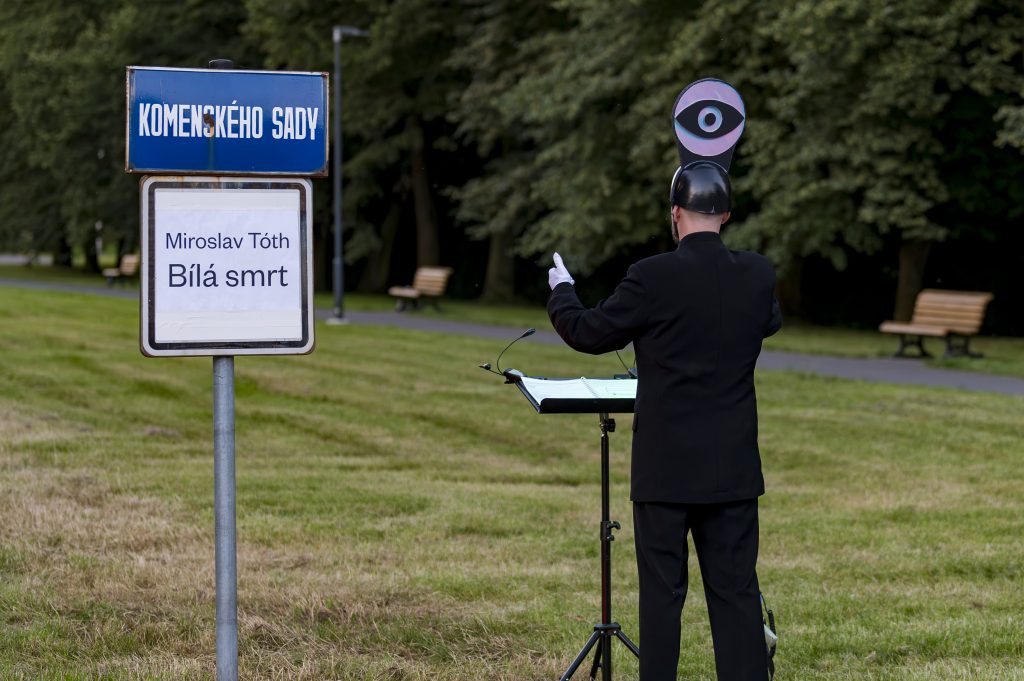
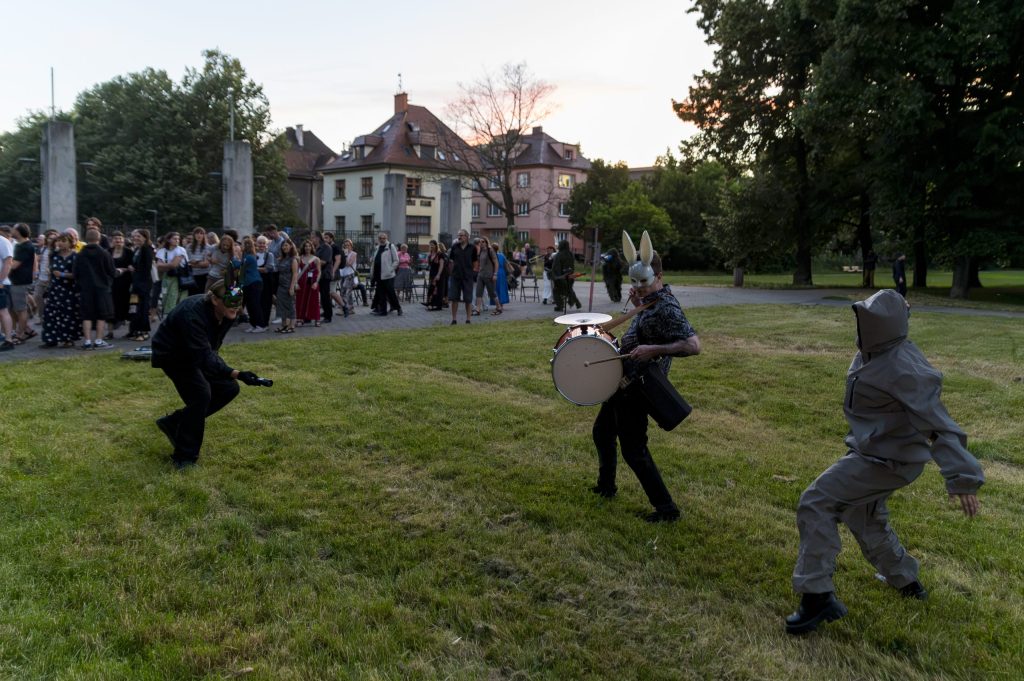
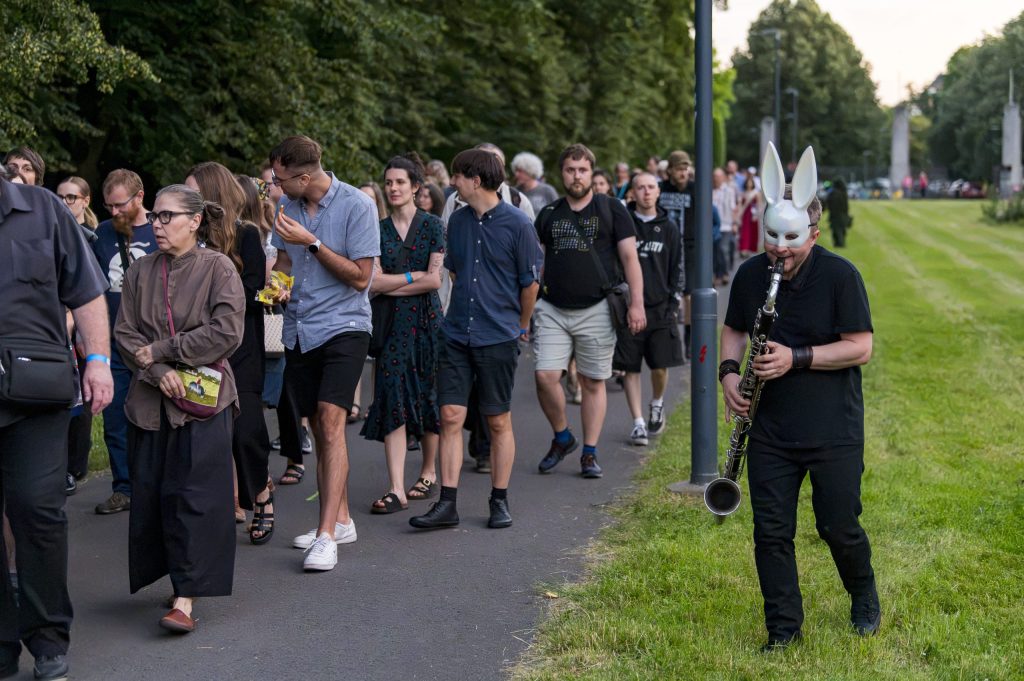
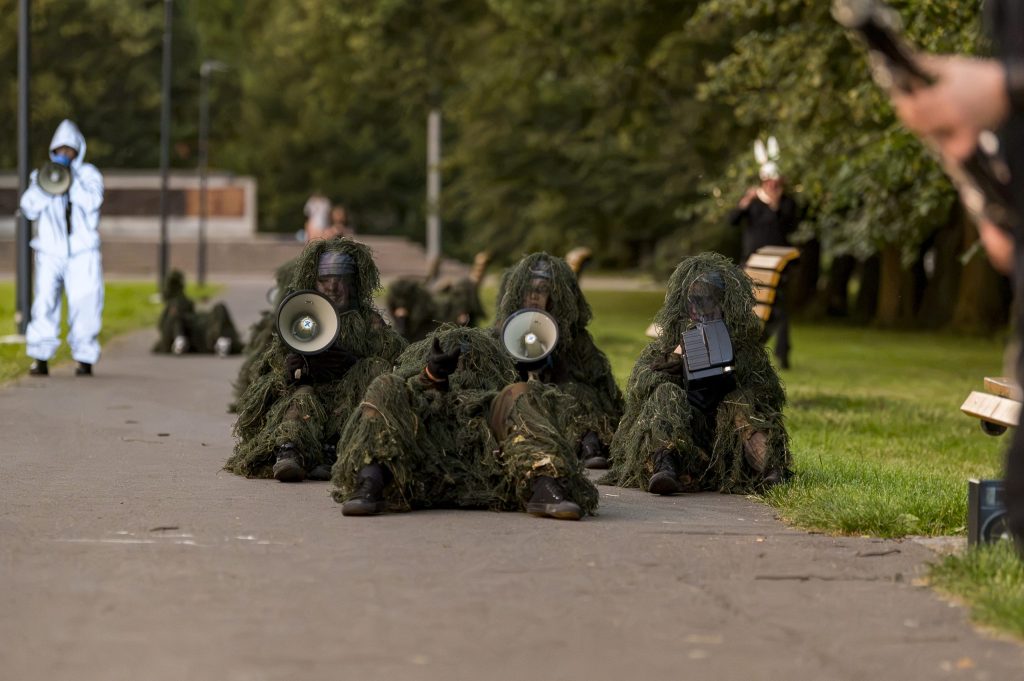
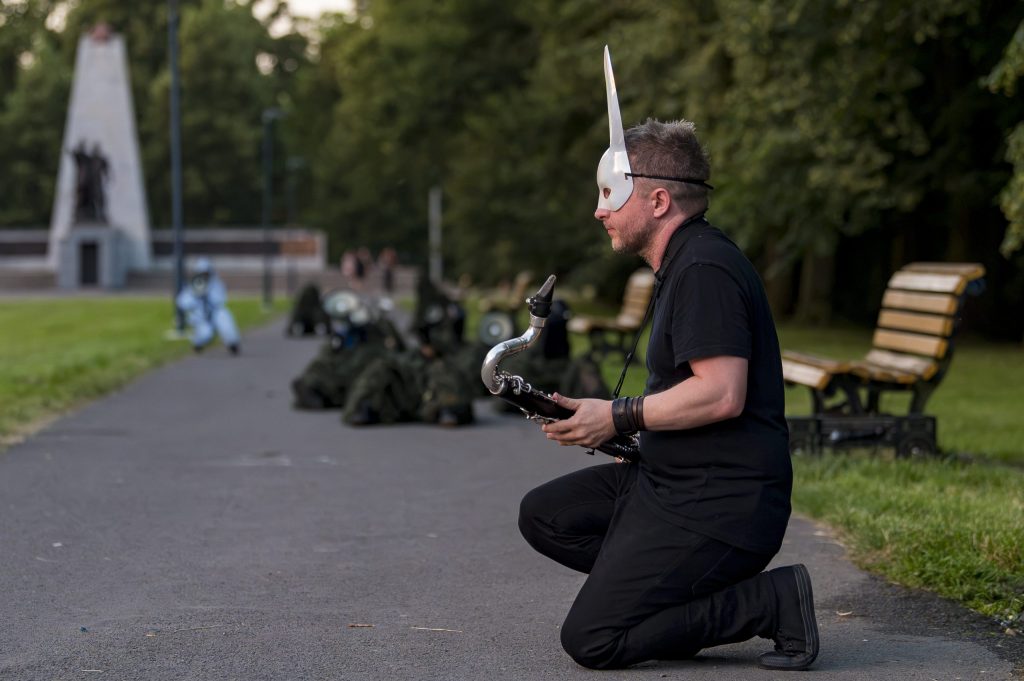
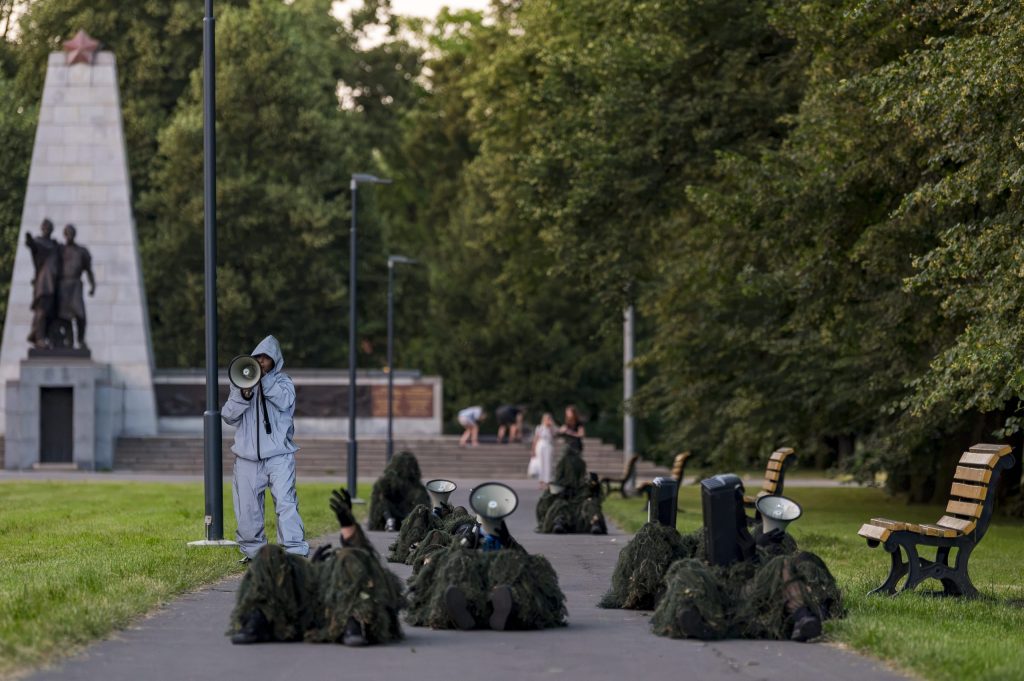
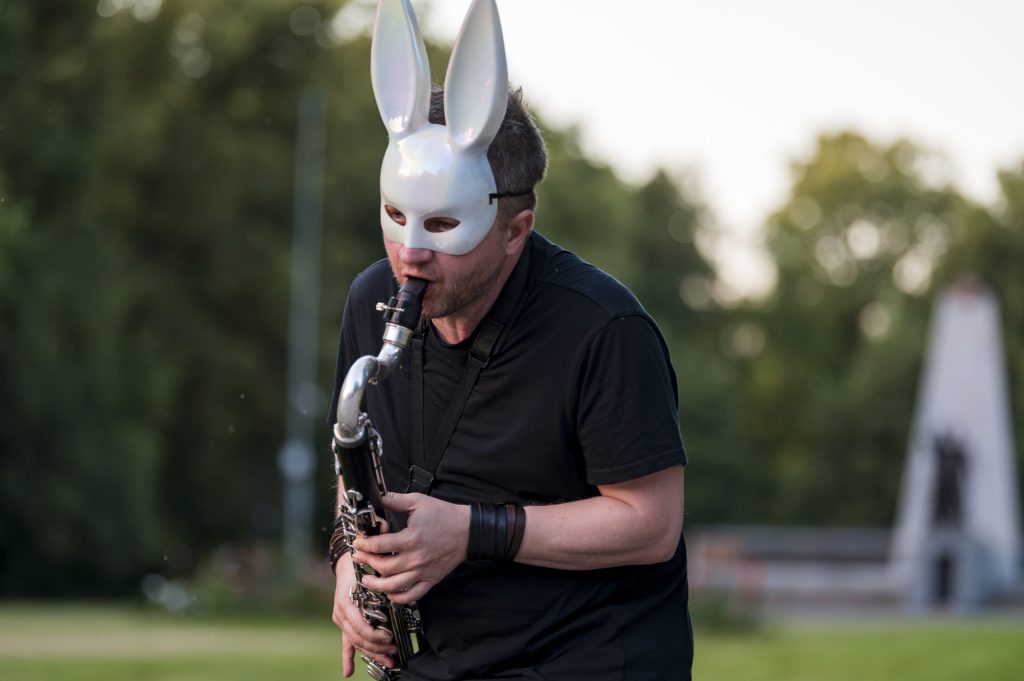
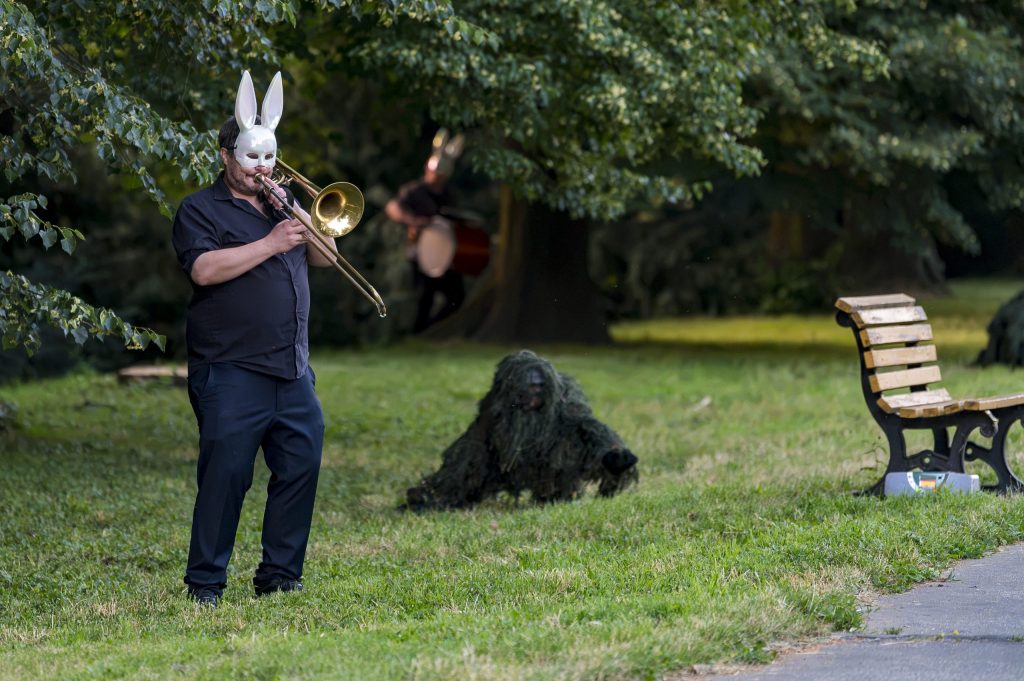
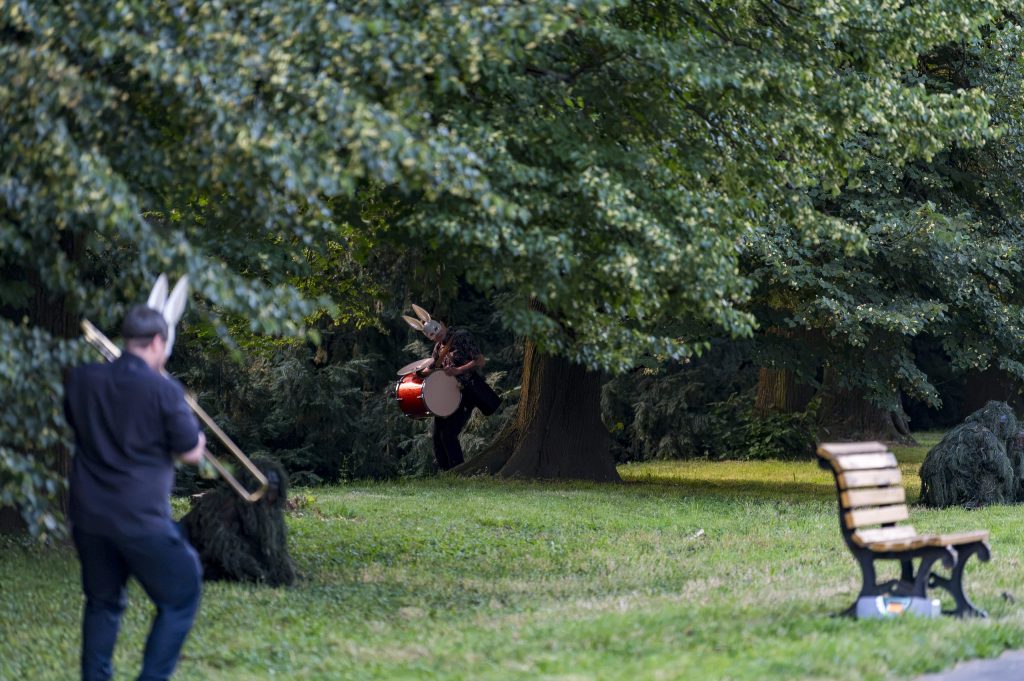
The first part of White Death unfolded outdoors in the expansive Komenského sady park, exposing the subtitle’s premise: “how humans taught trees to shoot”. Strange figures clad in ghillie suits (NODO Dance Company) and musicians dressed in black gradually emerged from individual bushes along the path. Together, they improvised the sonic landscape of the first act, evoking the inhospitable Finnish plains, complete with wild gales, low drones, and gunfire.
The shooting conjured the atmosphere of the Winter War between the Soviet Union and Finland, which saw the extraordinary exploits of sniper Simo Häyhä, famously nicknamed the ‘White Death’. His character duly appears on stage as a diminutive, stooped old figure in a silver jumpsuit. Since the entire plot takes place in the face of the planet’s imminent doom, Simo (portrayed by Portuguese soprano Beatriz Gaudêncio Ramos) has dusted off his marksmanship. Simo’s vocal delivery, which consists of howling unintelligible text into a megaphone, croaking, and wailing, dissolves into the sonic sketch of the bleak terrain.
The bizarre camouflaged figures, perhaps tree spirits or the personified trees themselves, respond to Simo’s wails with collective groans, interspersed with bursts of harsh rock music blasted from portable boomboxes. Gradually, these arboreal apparitions and the musicians (some hopping among the audience in rabbit masks) overtook the entire visible area of the park, effectively “herding” the spectators into the nearby OSTRA Sport Centrum tennis hall for the subsequent acts.
The Apocalypse Moves Indoors
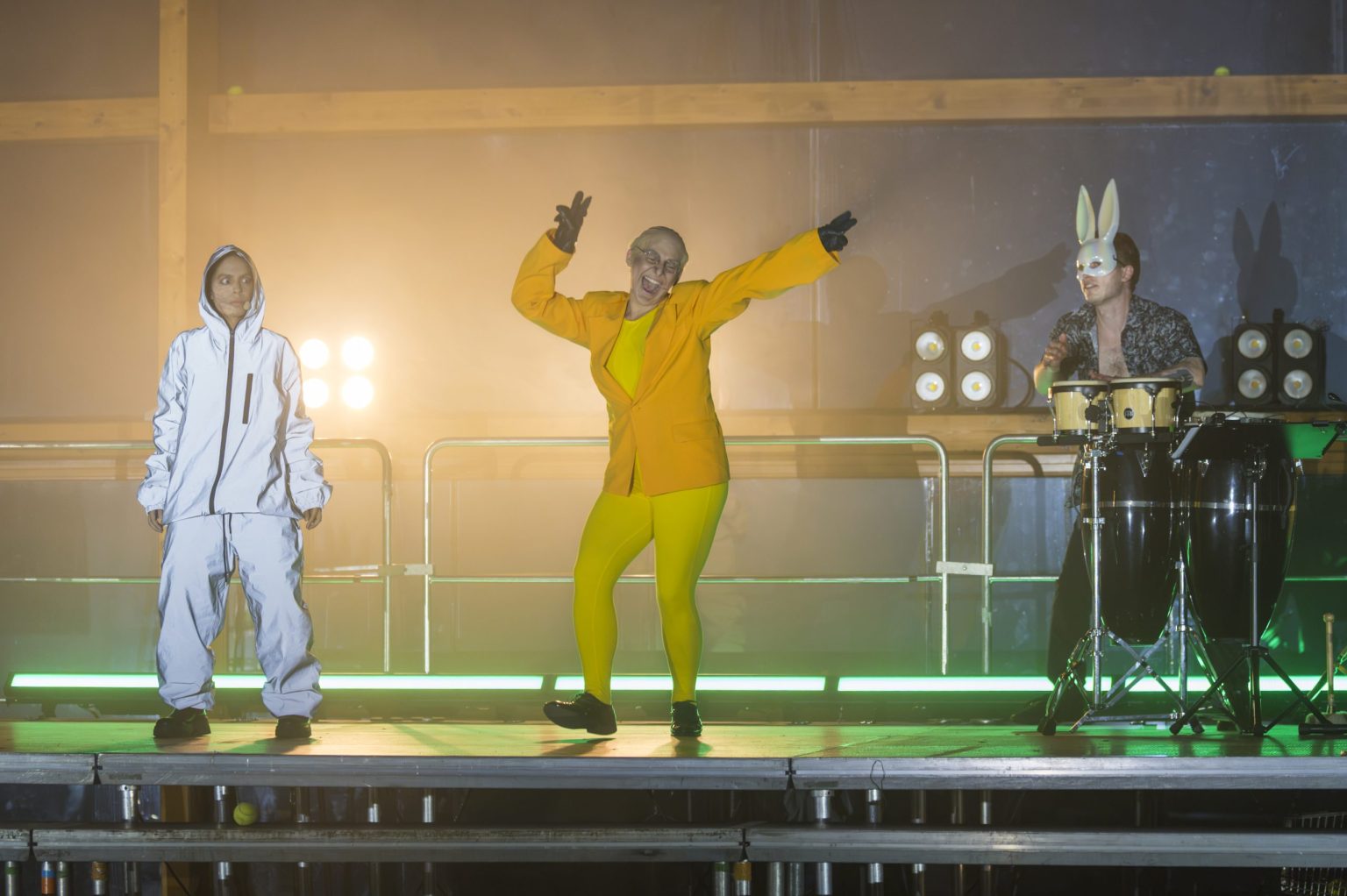
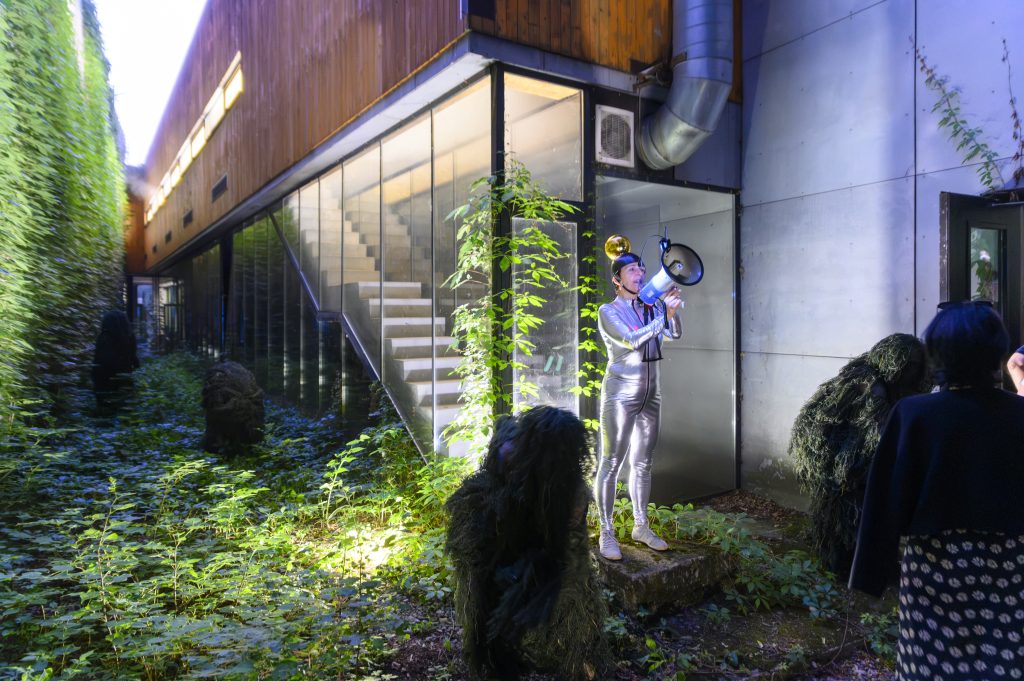
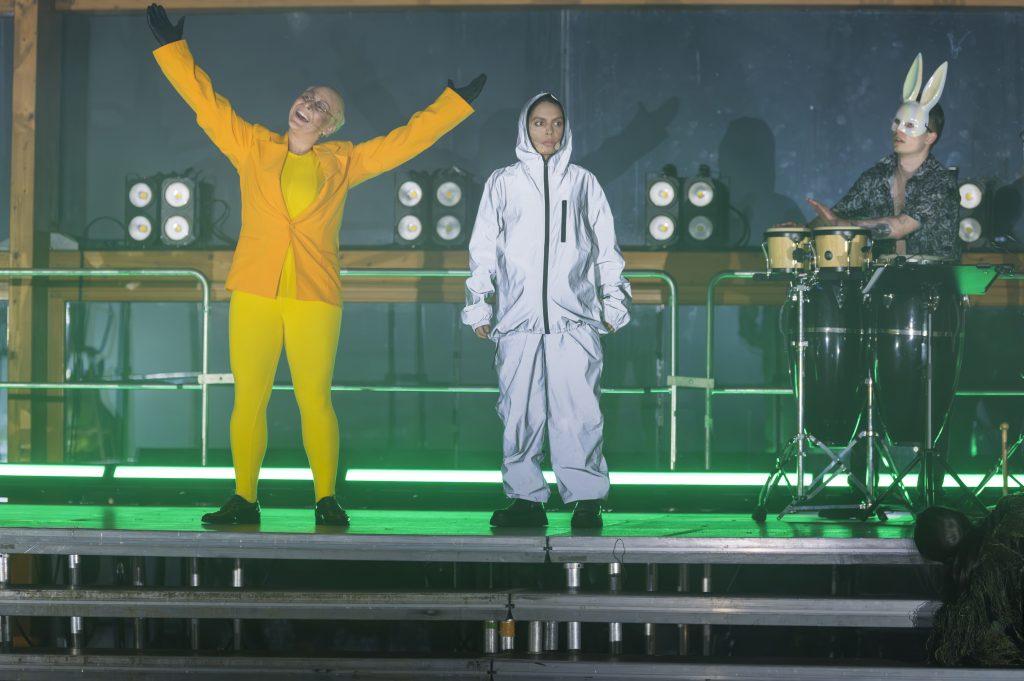
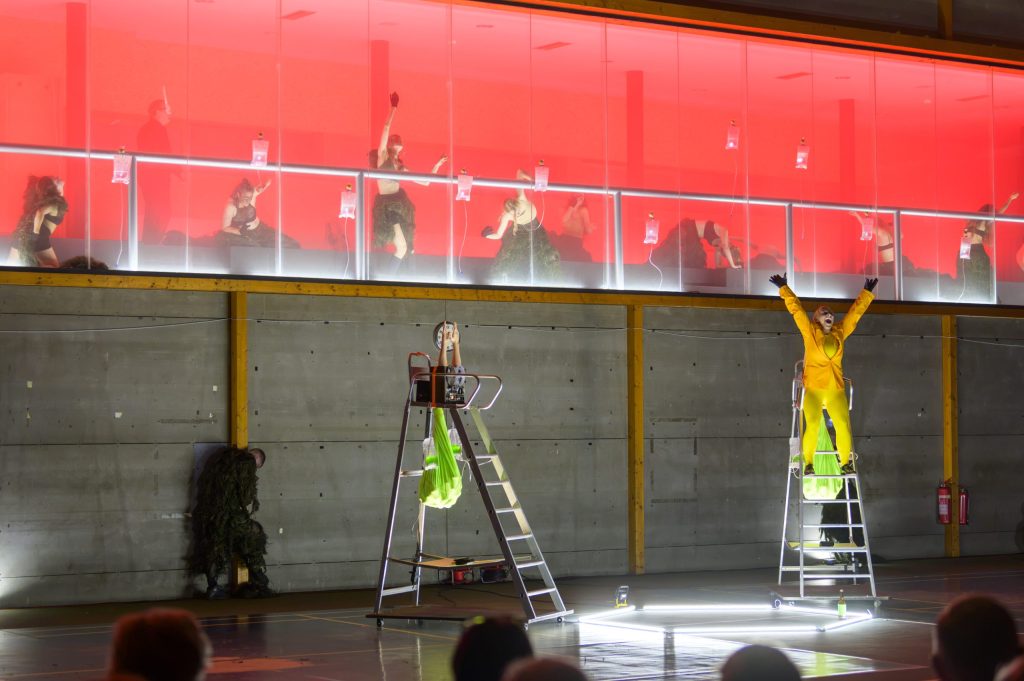
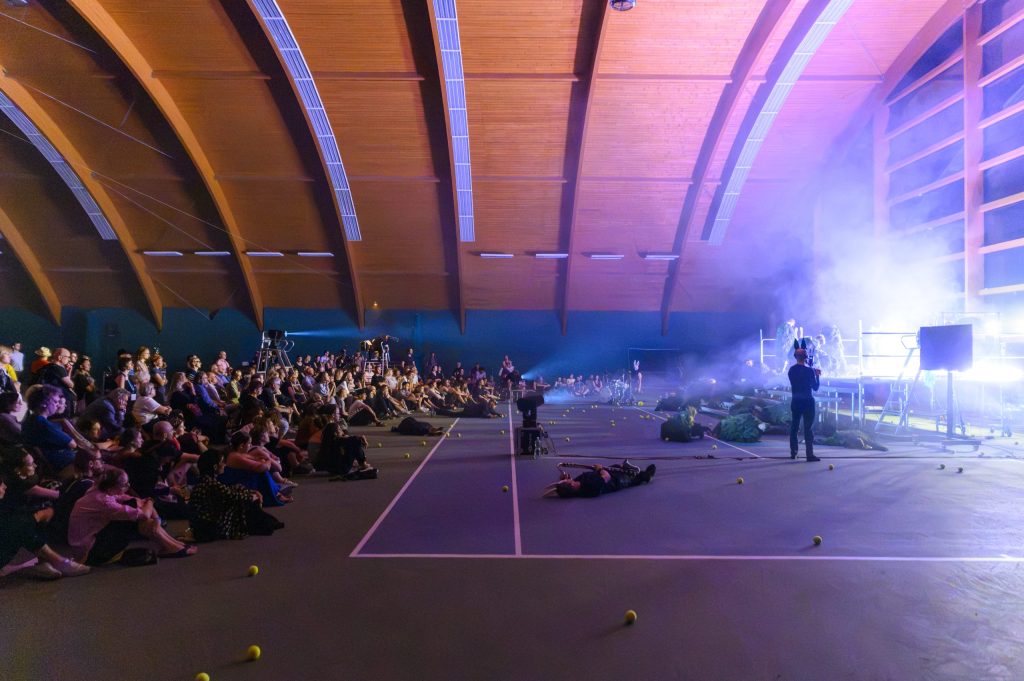
Right at the entrance to the hall, a figure resembling a reporter from the future (Renáta Spisarová), sporting silver athletic gear, addressed the audience through a megaphone to announce the impending destruction of Earth, soon to be melted by the Sun. In the gloom of the hall, illuminated primarily by a glass-fronted gallery shifting through shades of red, green, and white, another bizarre character plotted to commodify the apocalypse: the washed-up German telemarketer Horst Fuchs (Bella Adamova).
Unlike the role of Simo, the composer afforded Fuchs a much broader sonic palette. The primary medium remained the spoken word, modified into a sort of improvisational Sprechgesang and metalcore death-growls, which Tóth manipulated in real time from his life post. These utterances were punctuated by passages of free pseudo-operatic improvisation, shrieks, yelps, and eventually, a ubiquitous, all-encompassing canine howling. Musically, the composer coordinates a complex web of disparate instrumental and vocal layers.
Conductor Jan Bubák Scores
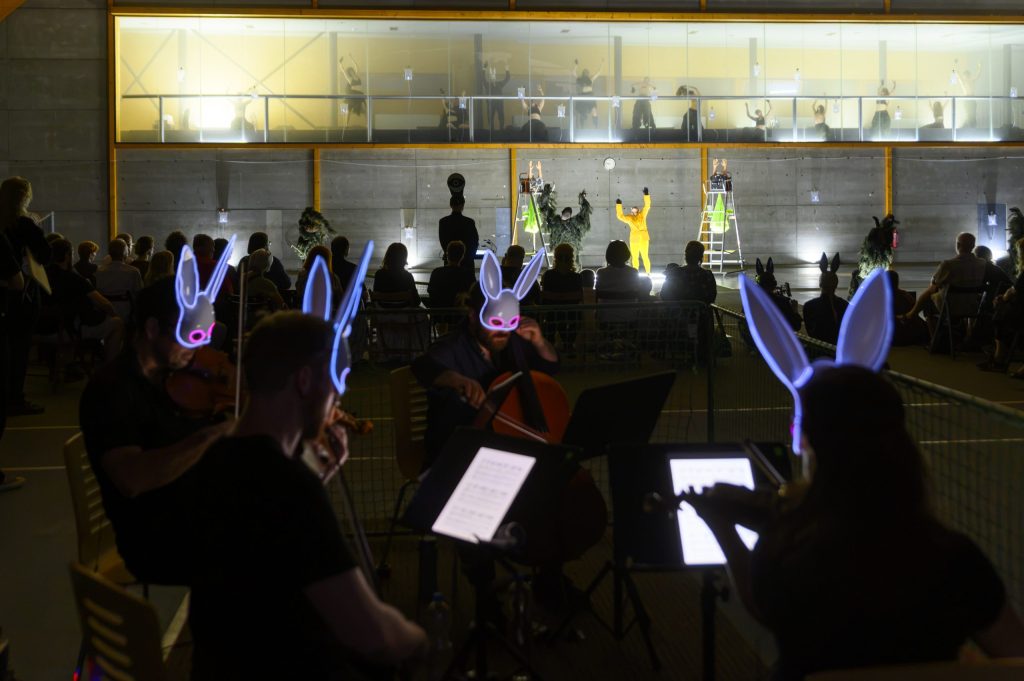
Seated in the dark at the centre of the hall, the American ensemble Mivos Quartet delivered a kind of apocalyptic funeral music laden with sighing glissandi. This music flowed in a “parallel time zone”, interrupted and cued back into play by conductor Jan Bubák in lockstep with Horst Fuchs’s individual addresses. Bubák was also in charge of thevirtual dialogues between Fuchs and two reel tape recorders. Fuchs converses with them as they were robots preparing for a new television broadcast. From both tape recorders came overlapping, wailing tirades (utterly incomprehensible to my ears) sung by the superb countertenor Jan Mikušek.
The production cleverly personified the robots by mounting the recorders vertically atop two umpire chairs, which were later transported to the opposite side of the hall by half-naked performers representing the camouflaged tree spirits. The remaining spirits crafted deeply striking movement patterns on the illuminated glass gallery, depicting the demise of all living things. Choreographer Pasi Mäkelä made excellent use of the somber atmosphere, wherein the spectator feels time slowing down, reinforcing the scene with images of ruin, agony, and civilizational collapse. At certain points, the protagonists were even hooked up to glowing IV drips.
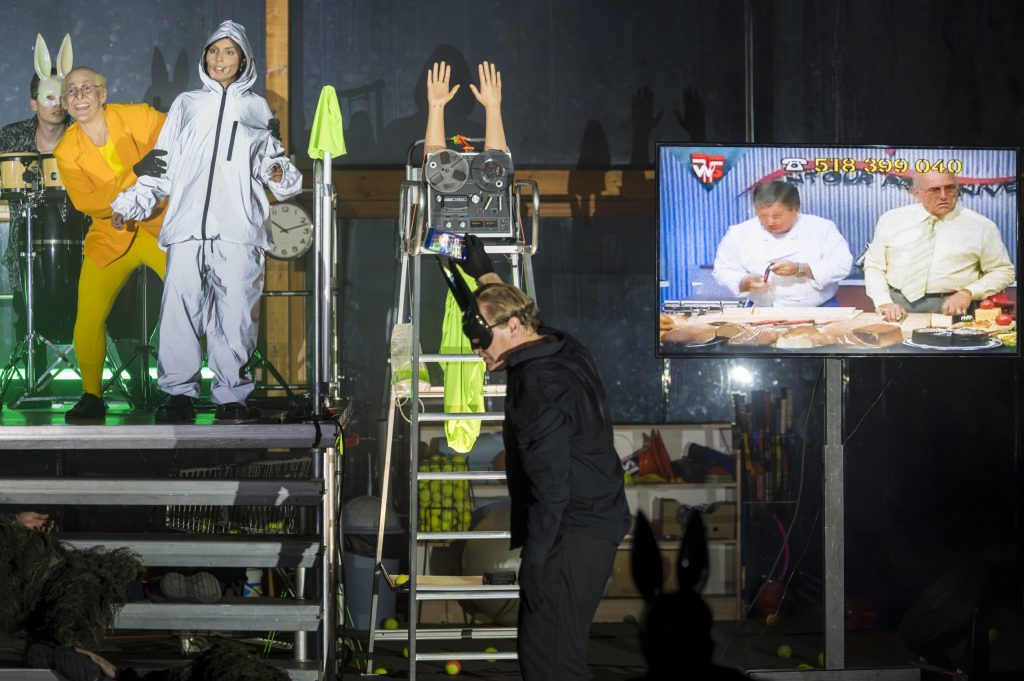
Amidst the morass of Horst Fuchs’s growled words, one could occasionally discern that he was addressing dying humanity, to which the spirits reacted with shouts, rasps, and further sessions of listening to rock music from their boomboxes. Their clamour eventually riled the conductor, who engaged the spirits in a brief battle using tennis balls.
Horst Fuchs Peddles the Last Hope
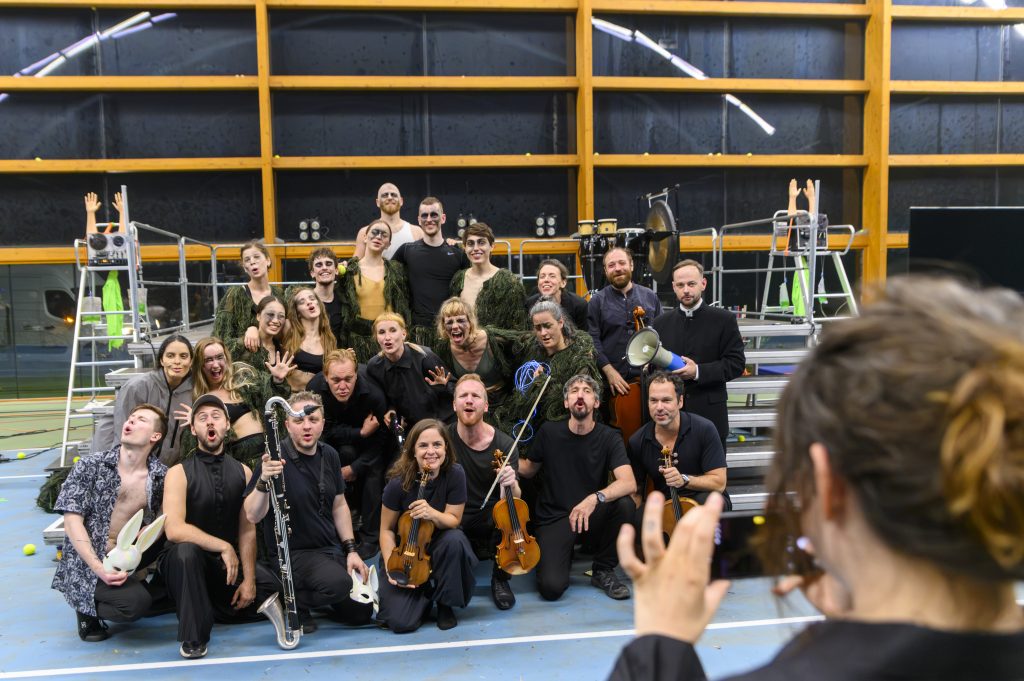
The true circus, however, erupted in the final section of the opera on the far side of the hall, where the scenography transported us into a television studio broadcasting a live episode of Fuchs’s infomercial. Here, a massive instrumental and sonic apparatus engaged: a drum kit, percussion, two trombones, bass clarinet, string quartet, live electronics, and various sound effects. The sprawling scene was directed from an illuminated podium by the conductor, who wore a mask of the Illuminati Eye.
The instrumentalists (with the exception of the Mivos quartet, which maintained its role as a musical constant from “another world”) clearly utilised improvisational material provided by the composer, which the conductor steered into a logical flow depending on the acoustic situation. What followed was a barrage of wild musical fantasies, roars, and shrieks, all marshaled to depict the blatant tastelessness and decay that Horst Fuchs had spent a career perfecting.
Fuchs’s iconic hits made an appearance, including the classic egg fried on the bonnet of a car commercial, assisted by the sniper Simo as a guest. The centerpiece of the teleshopping broadcast was the sale of robotic assistants designed to care for lonely humans during the final days of the world. Their demonstration, however, degenerated into total chaos and an explosion that killed Simo. The subsequent explosion of the entire galaxy, accompanied by a choral howling and growling of We Are the World, swept Horst Fuchs himself into the depths of nothingness.
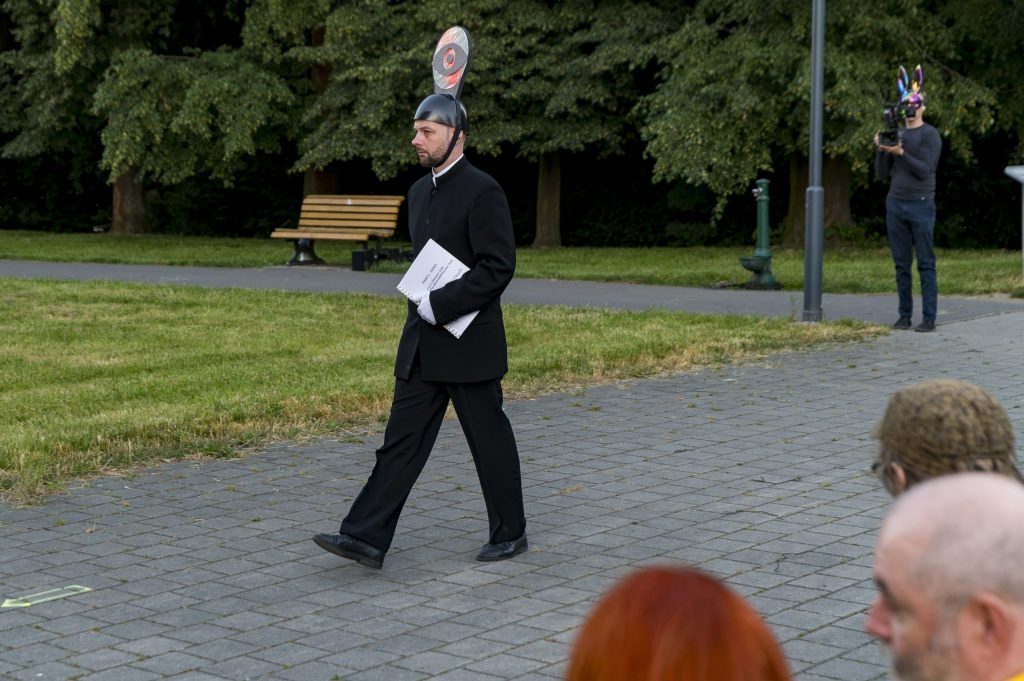
In terms of staging the pervasive atmosphere of eco-grief, the superb symbiosis of physical theatre, direction, and lighting design (Jan Husták) deserves unequivocal praise. Whether it was the effective directorial command of the vast park space, where the trees created the impression of a massive pack of terrifying phantoms despite the modest size of the cast, or the effects of the conductor’s luminescent hand, which lent the outdoor segment a sci-fi aura.
The pervasive undercurrent of ritualism, brought to the scenes particularly by the chorus of trees, coupled with the exploitation of the sports hall’s innate architecture, added immensely to the production’s evocative power. Similarly, director Kornetová staged the crowd scene featuring the studio explosion and the subsequent “dissolution” of Horst Fuchs and the entire planet with remarkable economy of means: a chaos of cascading tennis balls, and the wrapping of Horst’s figure in fiber-optic lights, upon which the entire image floated out of the sports hall, vanishing from the audience’s sight.
Mezzosoprano Bella Adamova naturally commanded the greatest share of attention. In the role of Horst Fuchs, she deployed an immense gamut of vocal techniques and dynamics, all while her performance was live-sculpted by Tóth at the electroacoustic mixing desk. Her spoken lines and improvisational vocalisations were firm, assured, and utterly transfixing. She toyed with the words and their distortion with manifest relish; it was clear she was inhabiting the music with absolute conviction. Adamova portrayed the telemarketer as a grotesque, self-appointed Master of the Universe, a megalomaniac whose frantic rush to squeeze out a few final euros only fast-tracks the apocalypse, even as he desperately tries to outrun his own solitary demise.
The Collapse of Language and Civilization
Conductor Jan Bubák fared exceptionally well under the pressure of such a demanding musical concept, binding the vast spans of music and coordinating the forces across enormous distances. He was fully integrated into the performance via theatrical actions and gags.
Tóth’s post-opera delivered not only well-balanced elements of musical performance, improvisation, and a sophisticated handling of independent musical strata and site-specific theatre, but it also raised burning questions about contemporary society. The dense incomprehensibility of the declaimed, sung, or shouted texts – from which the listener could only occasionally catch a distinct word or two, struck me as a fascinatingly applied compositional goal: a rendering of the total breakdown and degradation of human communication on the brink of civilizational collapse.
NODO – Miroslav Tóth: White Death
24 June 2026, 9:00 p.m.
Komenského sady and OSTRA Sport Centrum, Ostrava
Music: Miroslav Tóth
Libretto & Dramaturgy: Michaela Rosová, Miroslav Tóth
Conductor: Jan Bubák
Choreography: Pasi Mäkelä
Set & Costume Design: Matěj Sýkora
Lighting Design: Jan Husták
Direction: Nela Husták Kornetová
Ensemble & Cast:
Simo Häyhä: Beatriz Gaudêncio Ramos
Horst Fuchs: Bella Adamova
Androids: Jan Mikušek
Ensembles: Mivos Quartet, members of the Ostravská banda
NODO Dance Company (Trees): Emese Kovács, Nefeli Pantelia, Pablo Armenteros, Barnaby James Packham, Yu Matsumoto, Gvendolin Nagy, Mark Lawrence Griffiths, Dorottya Fanni Lengyel, Tom Jacques Lionel Julien Bellec, Jana Ryšlavá, Markéta Schacherlová, Isabela Ufrlová, Inna Kasianova, Viktorie Králová, Melanie Musilová, Julie Svitičová