by Hana Polanská Turečková
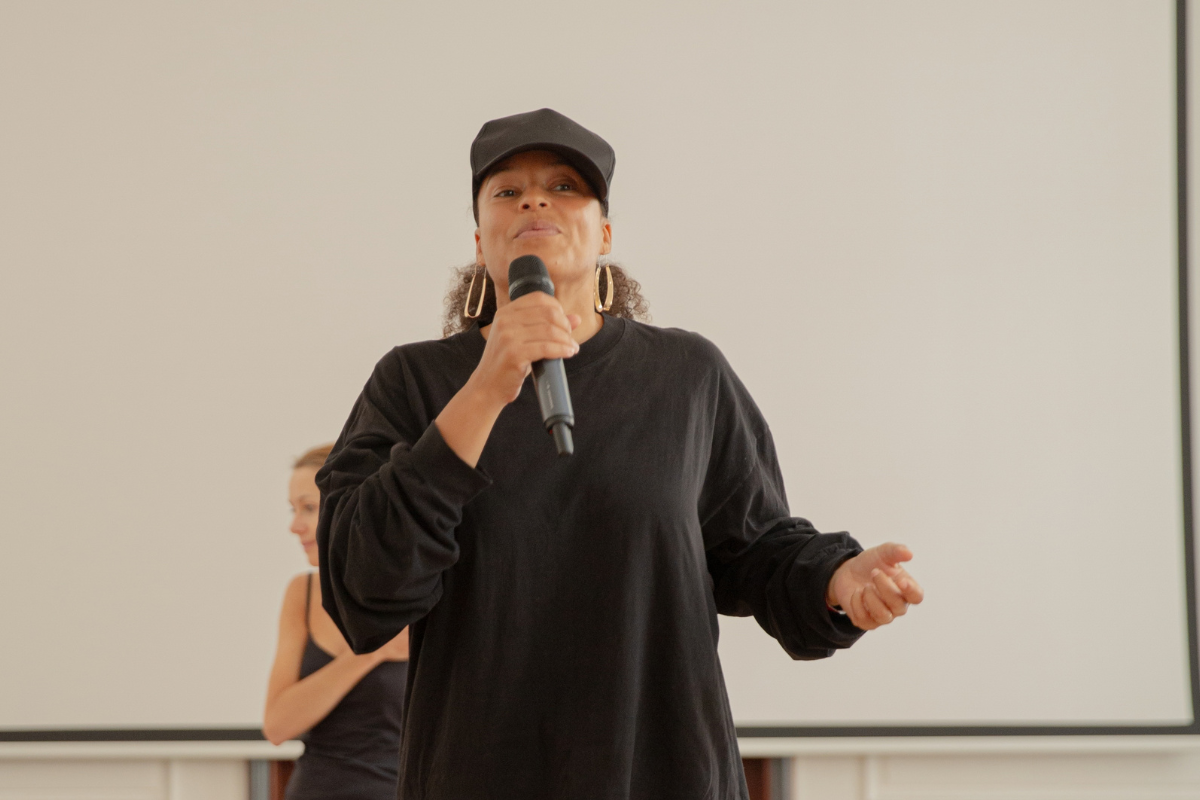
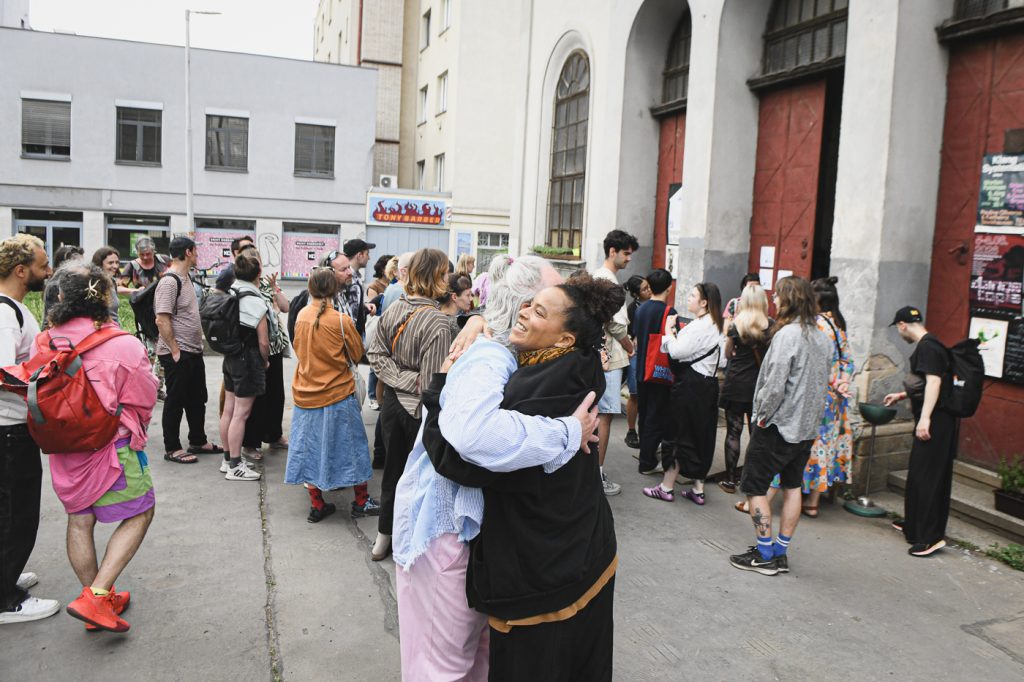
Isabel Lewis is a choreographer, artist, and theoretician known for creating socio-choreographic formats and “occasions” that combine movement, theory, and sensory experiences. Starting with the 2025/2026 season, she serves as the Co-Artistic Director of Tanzquartier Wien, a major European centre for contemporary dance in Vienna. This interview follows her participation in Dancetopia, a contemporary dance symposium held in Prague. Now in its third edition, the 2026 symposium focused on the central theme of Authenticity and Artificiality, curated by Alica Minar, Katarína Bakošová, Neva Guido, Breeanne Saxton, and Eduard Adam Orszulik. Lewis was invited as the main guest to lead a socio-choreographic workshop titled Doppelgänger, which took place on Sunday, June 7, 2026, at the Goethe-Institut in Prague. The project explored modern socio-political polarisation and was conceptually based on theoretical works by political scientist Hélène Landemore and author Naomi Klein.
You are trained in formal dance and choreography, but you also engage deeply with literature, philosophy, and social dance practices. Could you speak about the transition from a very disciplined world into more experimental and social forms of dance?
If I really break it down, I have to begin before my studies. I sometimes tend to think of my CV as starting with classical ballet, because that was transformative. It gave me a way to think critically about dance or, maybe more precisely, it eventually required me to think critically. I entered ballet too young to be critical about it, but as my political and social consciousness grew, I found myself still loving ballet while needing to understand it historically and culturally. That opened up a world of thinking for me, and it also pushed my ongoing interest in literature and philosophy.
But before ballet came into my life, I grew up in a Dominican family, drawing from cultural roots where dance is omnipresent and everyone takes part. Dance is social. Multiple generations dance together in the living room, in the backyard, in the garden, at the beach. Dance and life are deeply intertwined.
So even though my academic pursuit of dance came later, where I am now has a lot to do with this earlier experience: dance as a social form, as a way of experimenting with oneself and with one’s relation to others, to places, to things. That sociality of dance is what pushed me toward other, more experimental forms of communication.
Let’s speak about the practice you call hosted occasions. I read a little about it, but I am not sure what it really is. Could you explain it and also say more about your methodology?
It is important for me that classical ballet generated specific responses. When I began making my own choreography, I was confronted by what it meant to be on the European stage as a racialized and gendered body, as a Black woman. That confrontation was already there during my ballet training in Florida, in the American South: questions of race, and of course the conventional gender roles inside classical ballet.
Before I could make work, I had to ask: what does it mean for me to be on stage? How do I want to work with that? Can I work with that? I remember asking myself how I could possibly surmount everything already projected onto me as an image. If I am on stage, I become an image on stage. That provocation was very generative.
For many years I made works for the stage that challenged the relationship between audience and performer: how we see, how the audience perceives. I worked with light, sometimes reducing light or making seeing difficult. But after some time, I realised that maybe the question was not only what happens on stage, around the stage, or through the technique of the stage. Maybe it was the social contract itself that I wanted to affect.
This is where I arrived at the figure of host and guest as a transformation of the performer-audience relation. The performer-audience relation has a binary power structure. The performer may seem to be in power, with the audience subjected, or the audience may be in power, with the performer subjected to their gaze. It can flip either way. With host and guest, power remains, but it becomes more nuanced. The host carries more responsibility because they have created the invitation, but the guest is not in a categorically different situation. They share a social situation.
For a while I did not want to use terms like performance or event, because they came with too many preconceived ideas: sit still, face front, pay attention, be silent. I wanted another kind of behaviour from the public. I wanted to address them directly – not only their eyes, but their whole sensorium.
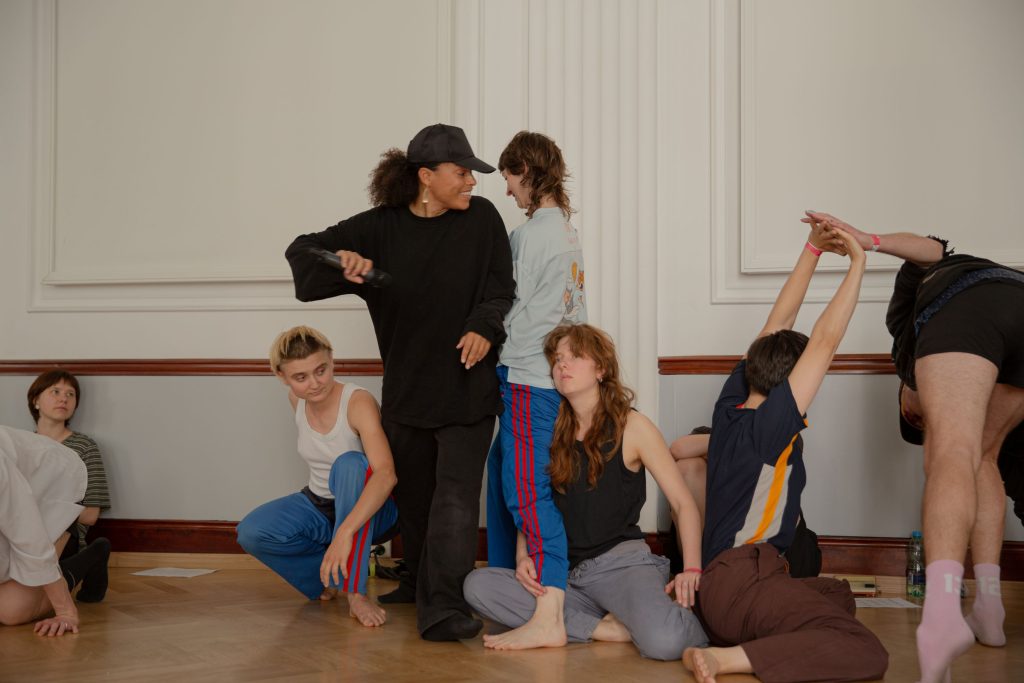
That is how I began to work on what I later called hosted occasions: choreographed situations with specific attention to space, light, sound, taste, and smell. I collaborated with chefs, with the smell researcher and chemist Sissel Tolaas, and sometimes with architects or visual artists. These works had a temporality closer to hosting a house party or a garden party: the doors open at a certain time, and the occasion unfolds over several hours. They are choreographed works, but the terms of choreography are different. It is not only what happens in the dancing body, but also how the public moves in space, what the space smells like, what it feels like, and how people are addressed—through storytelling, music, choreography, and the senses.
Could we shift to the Doppelgänger Workshop?[1] I am interested in political doubling: the moment when real discomfort with institutions, labour control, and the treatment of bodies is redirected into conspiracy thinking. How does the workshop engage with this? And how do you understand the movement of intelligent people toward the far right, something we also observe here after Covid, including among some ballet dancers?
I think it is complex. What I mostly observe, and what the Doppelgänger Workshop tries to work with, is the need to make sense. I see the workshop as a composed, structured space for collective research into where we are as a society, and who we want to be as citizens when we are together.
Through Covid, I felt very strongly that I no longer understood the political landscape. The geopolitical entanglement has become so complex. Perhaps it always was, but now we have so many streams of information, so much access, and at the same time algorithmic echo chambers shaping how we consume media. People struggle to make sense, and they want to make sense.
This is where I have compassion for what happens. I do not understand the movement into conspiracy, but I can recognise it as a dynamic of sense-making – often with others who affirm that way of making sense. What I can offer are other forms of sense-making: art, game structures, play structures, choreographic situations that challenge us to make sense differently.
It is a volatile time. We often do not understand the decisions of governments or people in power, and the need to make sense becomes very strong. Since I also feel that I cannot fully make sense of things, I try at least to practise with others those ways of becoming awake and aware: aware of my relation to another person, to power, to decision-making, and to the dynamic between the individual and the group.
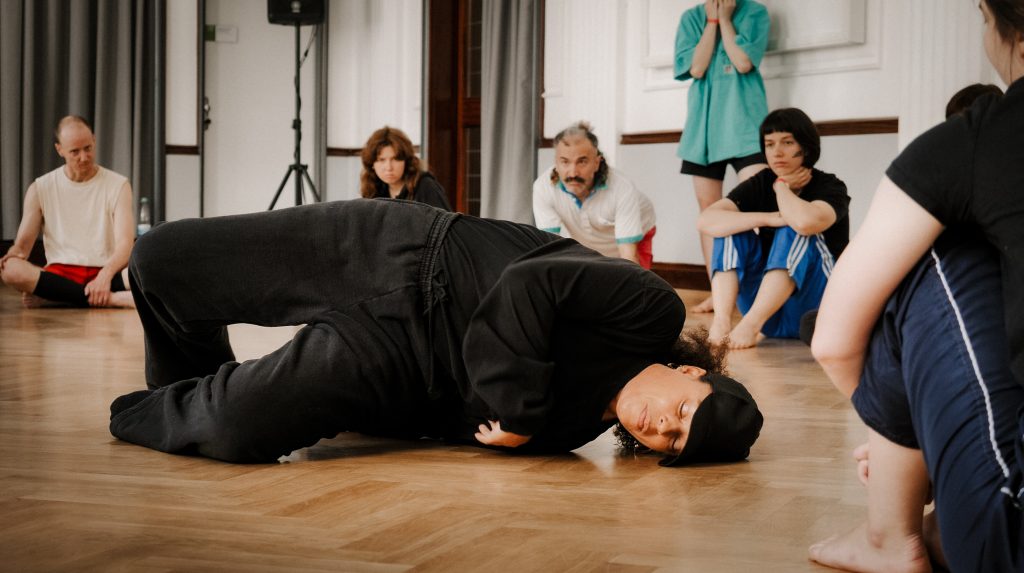
The workshop creates forms of being together, which I offer as choreographic scores. They give each individual space to observe themselves in relation to collective movement, across space and in the composition of situations. A central question is the degree to which the individual has, or does not have, autonomy.
One practice, for example, prepares us to consider the actual eyeball, the physiology of the eye, and the praxis of looking. It exposes how many different ways of seeing there are. That has a deep resonance for me, because it shows how complex any notion of truth is, and how complex any formation of memory is once it becomes registered as history. That complexity is already present in my own body, where different ways of seeing radically transform my experience of something.
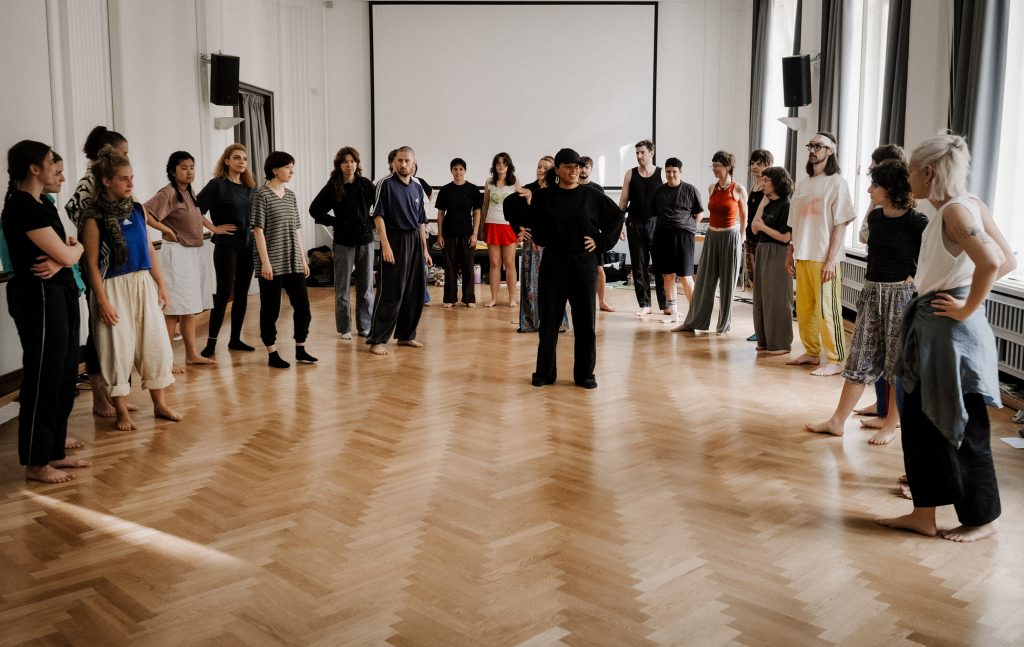
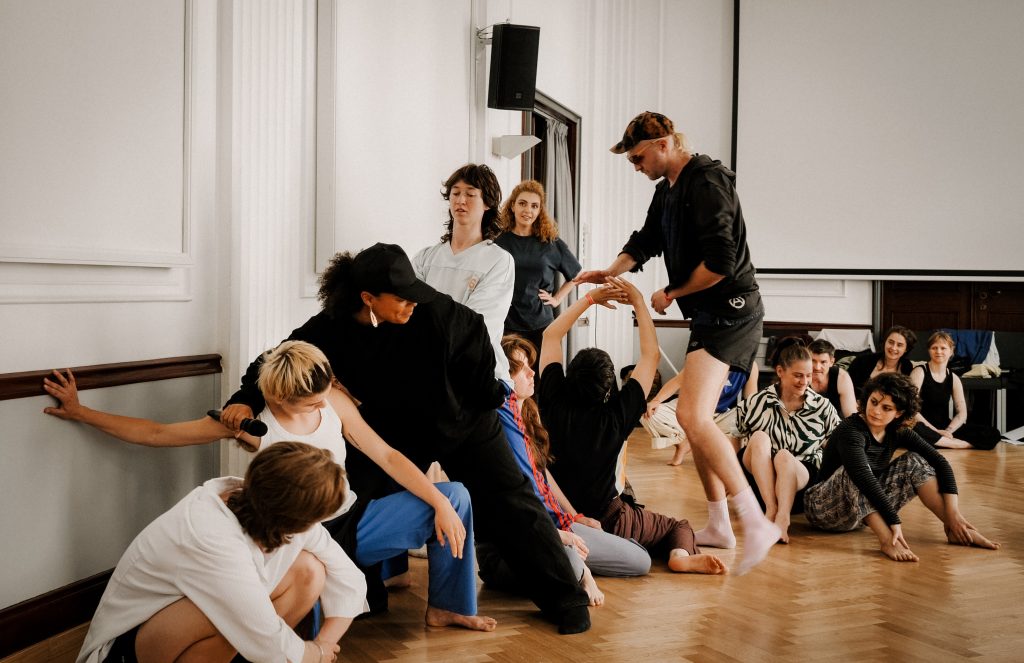
Then there are collective composition games, using scores for movement, seeing, and relating. We try to compose together without a single point of view or one director. You mentioned open democracy, and I think this is part of what I am researching. I mentioned Hélène Landemore’s Open Democracy, and I am still learning what that might mean inside a physical praxis. I would not say we are already practising open democracy, but the workshop certainly has to do with democratic decision-making. I provide materials that form a shared basis, and then the decisions we take together create the compositions.
Do you feel your work follows, or resonates with, experimental theatre and improvisational practices of the 1960s?
Isabel: Yes, I think those histories have influenced me, although I came to them through dance. I know figures such as Augusto Boal[2] who developed Theatre of the Oppressed, and other forms of political theatre. They are not necessarily part of my dance history in the strict sense, but I feel political theatre has gone very far because of its ability to work with language so strongly. It has developed rich artistic research around these questions.
In dance, because we often do not emphasise text per se, I sometimes feel we lack parts of that critical reflection in the making and doing. Of course, a whole new generation has trained differently. But I grew up in a very hierarchical training. From a young age, I learned what it means to take someone else’s direction on my body, execute it, and aim for the perfection of that execution. It becomes almost second nature. If a director gives you an instruction, you do it. That is what you are trained to do.
What I have tried to bring into dance praxis is connected to what I needed in order to be in the world the way I wanted to be. There are intersections with political theatre, but I arrived at them through dance. I often address a broader public, but through dance. What remains important to me is the search for a liberatory form of praxis for dance.
But you also read a lot. You seem nourished by very political books.
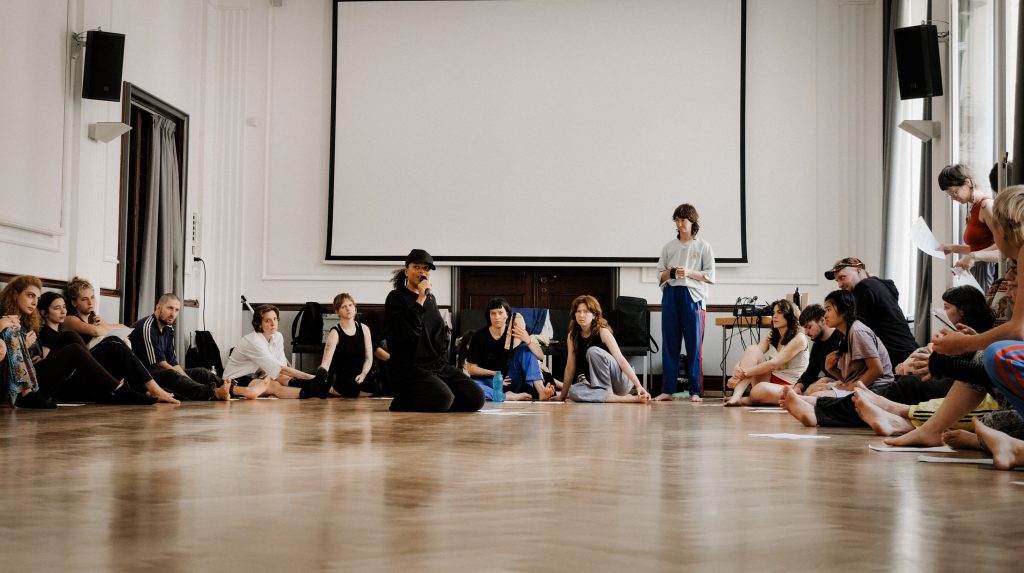
Yes, I love to read, and reading informs my practice a lot. What I love about literature and philosophy is that they remind me of the limits of thinking. As much as I love thought and the articulation of thought, I also love being reminded of its limits. This is where dance is an incredible form for me. Dance and performance have their own limitations, but the dancing body can synthesise complex positions and allow us to feel and experience things that go beyond logical expression.
That combination is important to me. I may be reading Sylvia Wynter, Frantz Fanon, Hélène Landemore’s[3] Open Democracy, or texts from cultural theory, political theory, or sociology. But I still require a physical praxis. That is where I feel I really start to understand something. In many ways, my artistic works are forms of digesting these inputs. I have a strong desire to create lived, felt affective experiences that help us register what we might learn from them.
Are there philosophers or theorists interested in your work? And as co-artistic director at Tanzquartier Wien,[4] can it become a kind of hub for sharing this thinking?
I hope so. Dance is still a marginalised and niche form. I have also had a very unconventional way of communicating my work: I do the work and it lives in the bodies of those I come into contact with. I have never used Instagram. Although much of my work unfolded within visual arts contexts, I never worked with a gallery. I chose other ways: public institutions, public space, academic contexts. And now I guide and lead Tanzquartier Wien. These are all forms of artistic praxis for me.
It is a practice people usually find out about by being there, or by word of mouth. So, it grows slowly. It is also not easy to document. But I know there is interest, because people working on PhDs contact me, ask for interviews, or want to follow up. Now that I am more rooted in one place, it is an interesting moment to gather these conversations and bring them together.
I think dance and practices like yours have strong potential, but sometimes we remain in bubbles. It would be important to push this more into public discourse.
I agree. This is one of my motivations for taking on the role of co-artistic director at Tanzquartier Wien: to advocate for dance as a contemporary cultural form that can speak to contemporary discourse and be part of it. It is not because there are not brilliant ideas, artists, researchers, or articulate people in the field.
I think this marginalisation is tied to a European cosmology that still holds a fear of the body – a fear of the messiness of the body, because the body exceeds standardisation and control. It can never really be fully controlled; it always leaks beyond its borders. I think that fear keeps dance marginalised, even inside institutions.
At the same time, institutions can be used. This is what interests me in working inside an art academy, an academic context, and now a cultural institution: to advocate for what this form can do, not only artistically, but also for philosophy, politics, sociality, and the way we think about the social sphere. There is very intensive research happening in our field.
Right now, I am exploring what it might mean to choreograph an institution, or to apply choreographic thinking and doing to an institutional frame. It is an experiment, and it is where much of my focus is now. I imagine it will remain important in my future praxis.
At the same time, I am becoming interested again in my own body as it ages. I am 45 now, still very mobile and capable, but I have moved for some time toward choreographing on an institutional scale, scaling up the body into collective bodies. Now I am also interested in returning to a smaller scale: the gestures my body produces, the gestures my voice produces, and the music and sound practice that I have maintained over the years. Everything you heard today is music I am producing or have produced. This intimate scale is becoming exciting again, as a place I want to go further into.
In the last decade of my work, I have often cast different generations, especially dancers over forty. Now I am there. Even in my thirties I was interested in what time does in a body, what experience does in a body. I loved those different textures inside a work. Now that my own body has entered the group I was always casting, I am curious about moving between the large scale of collective bodies and this small, singular scale again.
Do you think it is relevant today to return to a normal, traditional theatre setup, like a Black Box?
That is a great question. One of the beautiful things about taking on co-artistic direction at Tanzquartier Wien is that one of our main spaces is the Black Box Theatre, Halle G, in the MuseumsQuartier. We also have studio spaces where we produce, present, and rehearse work.
What I have seen is that the artist still has a lot of agency. Architecture does a lot, and institutions code many things for you. In our case, you go downstairs to the basement level, and that already creates conditions. But there is still agency in how an artist inhabits the space. The time that a choreographer’s world opens up, the textures of the body, the tensions in the room – these can radically transform how a space feels.
Seeing works in a Black Box week after week has made me feel that choreography still has enormous potential to transform a situation. I am most satisfied when the artist does not simply rest on the assumptions of the space but transforms it into what the work needs it to be.
At the same time, I love studio presentations that are research-oriented and have almost no production elements. I love actions in public space, and seeing things unfold there. I advocate for dance in all corners and places of life: from the home to public space, to the bus stop, and everything in between. Dance is such a human praxis, so relevant to understanding who we are and who we want to be.
The issue would be if the Black Box became the only site. But I still believe there is possibility inside it, especially when an artist takes it on as a real space. It is not the Black Box itself, or even the frontal situation as a dispositif, that is the limit. The limit is the degree of awareness of those conditions, and the willingness to work with them. Some works are meant to be seen frontally. If the Black Box is not taken for granted, if it is treated as a site with material and history, then that awareness can be felt in the work, and it makes all the difference.
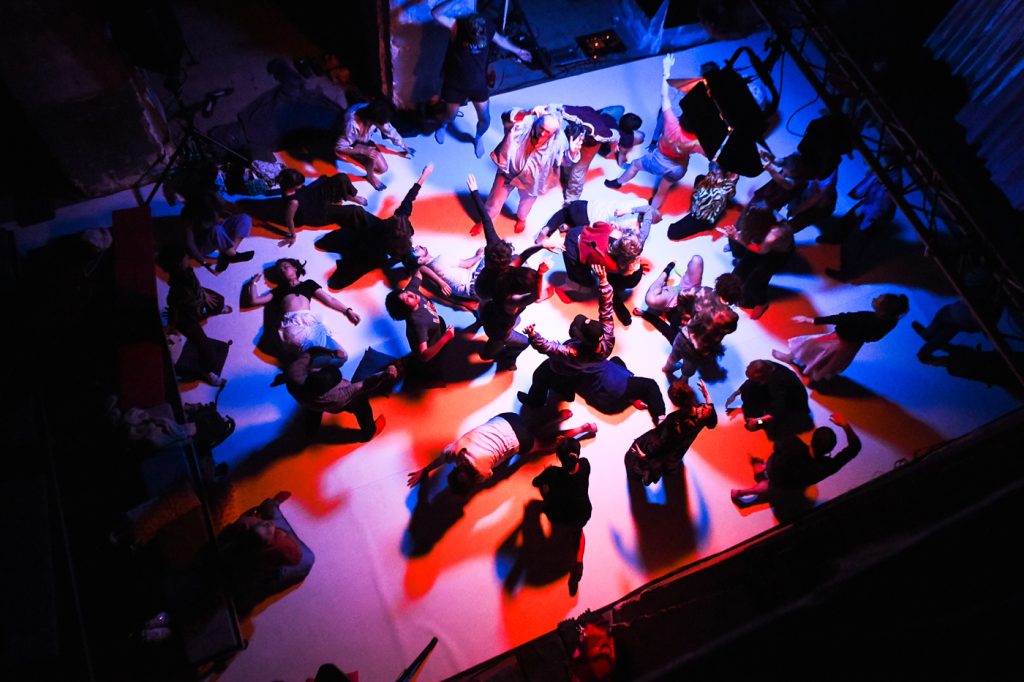
[1] The workshop Doppelgänger by Isabel Lewis was presented as part of the Dancetopia 2026 festival programme. The project’s title and conceptual framework directly reference Naomi Klein’s book Doppelganger: A Trip Into the Mirror World (2023). Klein’s work explores how our digital avatars, political polarisation, and conspiracy theories create a distorted “mirror world” that mimics and destabilises reality. In the workshop, this concept is translated into a socio-choreographic practice, using movement and collective improvisation to physically examine how opposing political views oddly mirror, blur, and intersect with one another in contemporary society.
[2] Augusto Boal (1931–2009) was an influential Brazilian theatre director, writer, and activist.
[3] Sylvia Wynter is a Jamaican-born cultural theorist, philosopher, and novelist. She is best known for her radical critique of the traditional, Eurocentric concept of the “human”.
Frantz Fanon (1925–1961) was a Martinican psychiatrist, philosopher, and anti-colonial writer. He argued that colonialism is a system sustained not just by military force, but by deeply internalised psychological trauma and racial hierarchies.
Hélène Landemore is a French-born political scientist and philosopher. She is a Damon Wells ’58 Professor of Political Science at Yale University. She argues that standard electoral representative democracy is fundamentally flawed. Instead of relying on career politicians, she champions “Open Democracy,” which integrates “civic lotteries” to select everyday citizens for governing assemblies.
[4] Tanzquartier Wien (TQW) is one of Europe’s leading centres for contemporary dance and performance art, located within the MuseumsQuartier complex in Vienna, Austria. Isabel Lewis took over as the Co-Artistic Director of Tanzquartier Wien starting in the 2025/2026 season, alongside cultural manager Riem Rutzinger.